

It’s Personal, Part 1
There’s a breakthrough that happens when we stand by our promises and earn the trust of patients who are willing to share their deepest struggles.
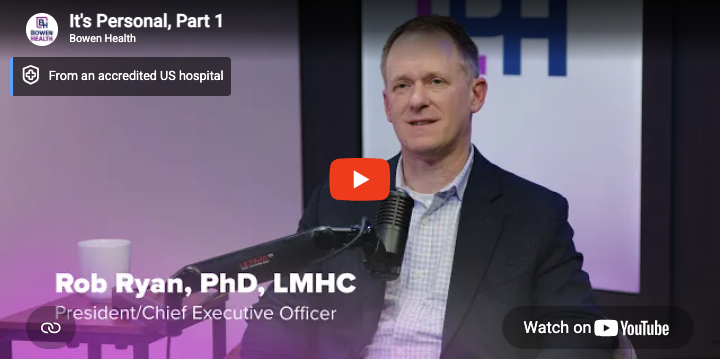
In part one of this two-part series titled “It’s Personal”, host Tess Ottenweller, Vice President of Intensive Services, sits down with Bowen Health President and CEO Dr. Rob Ryan for an honest and inspiring conversation about health, leadership and the power of showing up for people. As Dr. Ryan explains throughout the episode, for him, this work is personal.
Watch the video on our YouTube channel, listen to the audio-only version on your preferred platform, or read the episode transcript below!
Vodcast
Audio
Transcript
-
0:06
Welcome to the Bowen Health Podcast, where we talk about real life, real health, and what it means to take care of your whole self.
0:12
I'm Tess Ottenweller, Vice President of Intensive Services here at Bowen Health, and I'm so excited today to be joined by our guest, our president and CEO, Doctor Rob Ryan.
0:23
Doctor Ryan, would you like to introduce yourself for us?
0:26
Sure, I am.
0:28
I'm glad to be here today.
0:29
I know that when you first talked to me about this, I sort of ponder, I'm like people would want to hear us chatting about things.
0:36
But I have to admit, as I came up through Bowen, there was a lot of things that I wondered, how was that decision made?
0:43
Do they care about things?
0:45
Where is it that we're going?
0:47
And so I sort of pictured maybe after we talked, let's just have a conversation like we have in your office before trying to solve a problem or figure out where things are going.
0:56
So I'm definitely excited to be here.
0:59
As you said, Doctor Rob Ryan, I came here as an intern in 2004.
1:04
And I have to say that the 20 plus years that I've been here have been exciting.
1:12
They've been things that I've learned so much, made lifelong commitment to helping people who are in positions where in a lot of ways, they don't have a lot of choices.
1:22
And that's just a real personal thing for me, wanting to be in a place where I'm needed and able to help.
1:30
And I have to give a lot of credit to you too.
1:32
I know over the years that you're the same way.
1:34
You really want to help people.
1:35
So I'm excited just to have a conversation about that.
1:38
Awesome.
1:39
Yeah.
1:39
So I'm thinking, right, you're the president and CEO.
1:42
Let's take it back a little bit and I want to get a little personal.
1:46
Talk to us about what a healthy lifestyle means for you personally.
1:51
Yeah, that is definitely changed over the years.
1:56
Back in the day when I first started here, I was in my early 30s, did most of my work with children and adolescents, a lot of testing.
2:08
And you know, to connect with them, you need to be part of their life.
2:12
You need to know what they're talking about, what they're doing.
2:14
So for better or worse, I, I got the nickname of the skateboarding intern.
2:19
That was a lot of fun.
2:20
And so at lunchtime, I'd go skateboarding.
2:22
There were times where kids, after they're done testing, I'd say, what would you like to do?
2:25
They'd say, let's go skateboarding.
2:27
I'd do that, draw pictures for them, sort of whatever it is.
2:30
Back then, what health he meant to me didn't cross my mind very much.
2:35
When I thought about going to see the doctor, it was maybe if I was sick didn't happen very often.
2:40
You had to sort of nudge me to even go for an annual visit.
2:44
But now I have to say, as I've gotten older, I've been around for 20 plus years, as I've said, health is maybe taking on a different picture for me.
2:54
How I mean by that is I've started to realize that the decisions I make today are writing a check against my future 1020 years.
3:03
So how I behave now and the decisions I make today matters to how I'm going to feel and what I'm able to do 20 years from now.
3:10
So when I think about the things that I enjoy doing, family is important, hobbies are important, spirituality is important.
3:18
And in order to do those things, you got to be healthy.
3:20
And so I've started looking at health differently.
3:23
It's not just am I doing well today, it's what am I doing for the future because I, you know, as I get older than all of us think about wanting to spend time with our families, doing the things we enjoy.
3:36
If I don't take care of myself today, I can't do those in the future.
3:40
So for me, healthy has definitely changed over time.
3:43
When I think about patients, you know, clinician first here in my mind, I think about healthy is what their view of health is, what their goals are, what they want to accomplish.
3:56
Their worldview impacts that and I started realizing really on as a clinician, if I imposed my view, this is what I do.
4:04
This is how you should live.
4:06
It goes nowhere.
4:07
And so if when it comes to patients healthy, I I really focus on patient centered.
4:12
We've been doing that probably just what, 20 plus years since we've been here.
4:15
It's more than just words.
4:16
Patient centered really means what brought you here today?
4:20
Did we make progress in the things that you want to do?
4:23
And then lastly, my job has changed quite a bit to start making me think about the whole population.
4:28
So it was one thing when I was meeting one-on-one or maybe with a family, when I started thinking about all the 35 + 1000 people that we see.
4:37
How about the whole community's health?
4:39
And when it comes to that, most of the ideas about how we measure that are set by the state or by the government.
4:46
And what they usually say are things like Indiana health first, obesity goals, tobacco cessation, infant mortality, or at the national level, you have the these goals that are set for us that would say how many people there have gotten their blood pressure checked since they've seen you last time or their blood sugars and so on.
5:08
And so trying to pivot our heads to think about each of those depending on which realm we're in has been fun.
5:15
I enjoyed being a clinician, but I also enjoy sitting down with you going, how are we going to make sure that people care about their health today?
5:22
Because many of them don't see that 10 to 20 years.
5:26
They're writing checks on themselves.
5:28
And I also acknowledge that some of them are just trying to get through today.
5:31
And they're like when I've said, do you know how this is going to impact you in 20 years?
5:35
They're like 20 years.
5:37
I don't know what I'm going to eat for supper.
5:38
So I've really enjoyed all aspects of that myself.
5:42
What I think is healthy patients that I've worked with and now working with you and the other execs in, in the team on the whole system and how to get them to live a full and healthy life.
5:53
So I love that.
5:53
And I definitely agree with everything that you're saying.
5:55
And I, I just don't think all of that information is out there enough.
5:59
What does health look like?
6:00
Because it is different for every person.
6:02
And we we see a lot of individuals who might feel stuck or maybe the individuals were not seen feel stuck and don't know where to get started.
6:13
What do you think stops people from reaching out to start their healthcare journey?
6:17
Well, I think people often get stuck.
6:21
And I've totally done this myself.
6:24
I want to change something and I want some big grand gesture, a big one.
6:29
It is January 1st and I am going to give up sugar and that's it.
6:33
I love Donuts, I love ice cream, and I've just decided as of today I'm going without sugar.
6:40
It takes a lot of effort to do that.
6:43
The payoff feels like forever.
6:45
And not surprisingly, we end up petering out some time in January and we're like, we're done.
6:51
What I've found in life, working with patients and in my own life, the goal is to nudge your lifestyle in a direction you want to go.
7:00
Maybe instead of some big grand gesture of that's it, I'm done with sugar, maybe it's saying at lunch today I'm going to look at the portions and decide, do I want to eat all this?
7:10
Or I might say, you know what?
7:11
I'm going to choose one healthy thing to eat that I probably wouldn't have normally done that.
7:16
You take a step back in your own life and think about that in one year from now, which of those two things are more likely to have been adopted into your everyday lifestyle?
7:23
Because that's the goal, right?
7:25
I think that people get stuck trying to make grand gestures.
7:28
I'm going to fix everything in one moment.
7:31
And they don't realize the intense amount of energy and effort it takes.
7:36
And us as humans, we like to see a payoff.
7:38
So I think the cumulative effect of small changes over time are so much more important than that big grand gesture.
7:45
So, you know, why?
7:47
Why would people not call us?
7:49
Often?
7:50
They'll not call us because they're not sure that it'll make a difference.
7:52
I've tried, I've sat with patients and I've given them some ideas of I've tried that, it didn't work.
7:57
And when I was trying to encourage them is to say, have you tried that in the space where we're in now, which is about you, this is all about you.
8:05
And we're going to work towards something in a pattern that we think is going to make a difference.
8:10
And when they give that a try, often those smaller planful things that we make on our care plans make a difference in people's lives.
8:17
I love that, yes.
8:19
So one of the things I know that we've always kind of talked about, but more so now since we have started adding additional service lines to our service array, is the idea that mental health and physical health are connected, right?
8:34
You can't have one without the other.
8:36
So I'm, I'm curious, talk to us a little bit about why are those connected?
8:41
And it's so important to keep both in mind.
8:44
Yeah, You know, I'll say going back to my training either as a licensed professional counselor or as a psychologist, even within our own industry, 20 years ago, there wasn't a lot of talk about that.
9:00
The idea was, was specialization.
9:03
If you need your ankle work done, you go see an ankle specialist.
9:06
If you go need a shoulder, you go see your shoulder.
9:08
And so when it came to us, it would make sense.
9:11
We just focus on the brain, behaviors, the family, a system.
9:16
And what I started realizing is, is that we would make those small incremental changes like I was describing.
9:23
We'd break things down into parts.
9:25
We'd make progress.
9:26
People would start gaining momentum.
9:28
But you know, people would seem to get stuck.
9:31
Maybe they'd go, this is a lot of effort.
9:33
I don't know if I can do that.
9:35
And it started making me feel like there's got to be something else.
9:39
And it happened to be around that time, then I came across an article and it was published by the National Institute of Health.
9:48
And if you've ever heard, I I believe in the the power, the transformative power of love.
9:54
And when it is talking about love in counseling, there's obviously boundaries around that.
9:59
It's about unconditionally being there for someone and be focused on their needs in this session.
10:05
And I read this article, and it was focused on the fact that said if you were diagnosed with a serious mental illness in your 20s, that you will end up living around 20 to 25 years less than a person who doesn't have a serious mental illness.
10:21
And I was 10 years into my career, still practicing, meeting with people.
10:25
And it was one of those things where when it's on a sheet of paper, it's like, oh, wow, that I wouldn't want to live 20 years less.
10:35
And when the average, you know, life expectancy for women is around 80, men around 77, we're talking in their 50s.
10:43
It stuck with me, not at me.
10:46
And then it happened where it was very personal in transitional living, of course, with with what you run.
10:52
We had one of our homes and a patient who'd been with us for about 20 to 25 years off and on in care.
10:58
They would come in, they would get services, they would leave, they would come back.
11:02
They ended up passing away at 51, a female and I went over just to see how the staff were doing.
11:08
You can imagine working with someone over 20 years, you, you get close to them and they matter and tell the story.
11:17
Essentially, we were their family.
11:19
And when I was just debriefing with the staff and just tell me about, you know, them and the stories and how much we cared for them donned me.
11:29
I just said, what did she pass away from?
11:32
And they happen to see, I don't even know why they had this, but they were like, well, we have the death certificate right here.
11:37
And I was like, what does it say?
11:38
Just intrigued.
11:39
And it said natural causes.
11:41
And it really made me pause because I'm like, it's not natural at 51 to pass away as a woman.
11:50
And so it went from reading this article of hypothetical people dying 20 years to this is family.
11:56
This is someone we care about, we cried over, we cared about.
12:01
We have to do something about this.
12:03
So for me, the first connection at a professional level of health, physical health and mental health was realizing that the cumulative effect of small choices.
12:14
Like I mentioned before, not all small choices are good ones.
12:18
The living in poverty will often goes hand in hand with mental illness.
12:23
The breaking and thinning of emotional relationships with with your community, the medications that people receive, the difficulty accessing care that you and I take for granted, the ability for a person to just reach out when they're not feeling well and lean on someone.
12:41
They tends to become harder and harder for someone who's struggling with mental illness.
12:45
The cumulative effects of those negative health impacts are what contributes to a person who's maybe chronologically they're 48, but really their body is acting more like a 70 something.
12:59
So for me, profession was like, we have to do something about this.
13:01
If we say we care about someone, I can't sit by and watch someone that we care about just die 20 years earlier.
13:09
So this idea that, you know, cumulative effects matter.
13:13
It was well, then let's investigate what can bring some of those years back.
13:18
And while there's some debate over exactly what are the causes that take those years away, there's pretty clear consensus that it's where we've have been heading over the last five years.
13:29
If people wonder, well, why did we bring, you know, physical health or even dentistry in there?
13:34
It really came down to caring for the people that we serve.
13:39
And I am really excited that it's impacting already some of the people who are in our system.
13:45
But I think you and I have talked about this today at a Bowen location.
13:50
Somebody's going to come in and get for the first time, a serious mental illness diagnosis in their 20s.
13:55
And because of our system changes that you and I worked on that, our staff worked on that, we work to change our system to bring additional services in.
14:05
That person's going to live till 75 and 80.
14:08
Maybe long after we're gone, they'll still be living a healthy life.
14:12
And I think unless we started seeing those two things together of mind and body, it just wasn't going to happen that way.
14:19
In a little bit less dramatic way.
14:21
Maybe you don't have a serious mental illness.
14:23
Maybe you're just thinking, how does this impact me?
14:26
You know, just living as a human.
14:28
What chances are you at, you know, let's say lunchtime to do something different, like I'm going to go for a walk.
14:35
If all morning you've been under stress, frustrated in a job you don't like, working with people you don't like, and then you're like, I'm going to go for a walk, forget it.
14:45
Small decisions add up.
14:48
And I think this idea about the way you think impacts the way you feel and the way you act.
14:53
And it is that feedback loop that the way you feel impacts the way you think is really one of those things where even just take away the serious mental illness and in our everyday lives, the chances of you making positive health impacts on your life diminishes.
15:09
If during the day you're not taking care of yourself, doing those small little things, Get up from your desk, stop in and say, Hey, what are you doing?
15:16
Are you working on this?
15:17
I have some idea.
15:18
Pop in your office, pop in other executives office to feel things, go out and see our our patient offices, go back to the administrative area and just talk to people.
15:28
That's invaluable.
15:29
And so for me, the physical and mental health aspect of it is long overdue.
15:36
We're just starting to include it in our education.
15:40
I think that you and I would both know that when we went through, you know, our counselor training, it was diagnosis, exposure to the different types of treatments, making sure we got comfortable in that room, checking ourselves.
15:55
As I'm seeing new graduates come, this stuff is just natural to them and I love it.
16:01
So they're bringing great new ideas to us to make sure that we push even further from just physical health being primary care and mental health.
16:07
It's how do we insulate people from these things that just drag people down and steal years of their life from them.
16:14
So I'd love to hear you say that because I can remember growing up through our system and talking about it.
16:21
And when you first started talking to all of us about that 20 year life expectancy difference, I mean, on the surface it was like, what can that really be true?
16:30
And then looking more and more into it, you know, it's our friends, it's our family, it's our community, it's our neighbors.
16:36
It does become real.
16:38
And thinking back to my direct practice when we didn't have primary care, when we didn't have dentistry, you know, referring individuals you were working with and hoping they would follow up even the education and talking to them about that mind body connection.
16:56
But going to another provider, going to schedule another appointment, show up for another appointment, that's a lot of work and that's hard.
17:05
So I am so incredibly proud of where we're at now, being able to walk someone down the hall and say, hey, let's get tests scheduled for a primary care appointment and vice versa.
17:16
And you so cool is I remember being in a clinician seat 20 years ago bragging about how forward thinking bone was because we had a psychiatrist down the hall.
17:25
Yeah, I'm here at the in my internship site and I'd go back, talk to my other interns who read other placements and they would the only support they had was this once a month supervision.
17:35
And I'm like, I have experts down the hallway.
17:37
Back then, it was like that was forward thinking.
17:41
And to think that Bowen is maintaining that leadership position of trying to be at the front of the pack, bringing the best to bear for our patients is something that I'm proud of.
17:51
Because we could have just stayed.
17:52
It was great.
17:53
But we could have just stayed and said, yeah, well, that's great.
17:56
We have all the mental health ideas you can think of.
17:58
We'll wrap around it.
17:59
This is one of those things where I hope people who were in our position before is doing the same thing.
18:04
You know, I can walk a person down because their tooth hurts.
18:07
I mean, that would be if I could go back in time and tell myself, and someday you'll not just be able to go down and talk to a psychiatrist, you'll be able to talk to a dentist.
18:15
It would just be like, or a, or a pharmacist.
18:18
Oh my God, 20 years ago could be like, what?
18:22
Totally innovation is so, so cool.
18:25
I do remember being in a meeting with you years ago before I was on executive team and we really have the, the relationship that we have now.
18:32
But one of the things that you said to me that always stuck with me and honestly really changed my outlook and perspective on on why I do what I do.
18:41
And it was people are worth showing up for.
18:44
And that is a phrase that you've said before that again, I use it with staff, I talk about it all the time.
18:50
It really guides the way I think we all show up everyday and I think that leading our innovation we are in, we are doing some incredible things and I can't wait to see what we continue to do.
19:03
But I don't know if you want to comment on that phrase at all, but it is just always hit me and I know all the the staff I work with.
19:10
Yeah.
19:11
So again, back to how we were trained compared to today, there was this real clear boundary over you don't share things about yourself.
19:19
I actually, again, really appreciate that with some clarity.
19:23
There are some things that are important to share about yourself, whether or not that be in treatment or in a leadership position.
19:30
So where that came from from me was, you know, we used to have a manufactured home up in the Syracuse area in Enchanted Hills.
19:40
We would take people through who maybe hadn't experienced what poverty may look like living in a less than safe home.
19:50
There were different aspects that were just typical things that you would encounter.
19:54
I remember the first time that I went there after we had set it up and I walked inside and I was maybe the third or fourth person in and the one of the first two people said, whoa, man, do you guys smell that?
20:07
And I remember when I walked into the door, the first thing that hit me was my uncle's house.
20:14
And and I was like, OK, this is different.
20:16
And they were talking about the smells they smelled in there and the things.
20:19
And all I was thinking about is the fun I had, the way that I looked up to him.
20:24
And so I always came at this from this standpoint that I'm in service to people that are just like people from my family.
20:33
And then I have hope that people are treating them if they need help in the same way that I want to treat people.
20:39
So I, I kind of looked at it that we show up in, in this manner of basically saying we're not doing a service to somebody.
20:46
I'm not in a position of, you know, well, let me show you how to live your life or this is better.
20:52
We all have aspects in our personal life or in our family life that when we see someone in front of us, I often say it's I value you right now.
21:03
Not if you stop doing this, if you take my lessons and apply them, if you work and you get your life in order right then and there, whether it's their house, the environment they work in, the job that they have, who they are, whatever relationships are in, whatever trouble they've been in, whatever things they've done to other people.
21:21
I, I just want us to show up and to say I'm here for you.
21:26
I've had people sit across from me in tears after pushing my buttons and yelling and telling me to get away from them and leave them alone.
21:35
And after either time or multiple sessions, there's a sense of they look at me, they're like, you really aren't leaving me, are you?
21:42
And I said, well, no, I'm here for you.
21:46
And the breakthrough that happens when a someone who's constantly let down in this world meet somebody who's just there for them.
21:54
I actually think it's something unique about Bowen that again, I appreciate all the health systems around us.
21:59
And I believe primary care doctors and dentists who work independently are wonderful.
22:04
But a lot of the patients who see us are just used to being let down.
22:09
And I think that in some ways they test that because why get hope again if I'm just going to be let down again?
22:16
So I'm going to meet Rob, OK, Who's this person?
22:18
It's another person who's going to make promises, tell me that he's going to be there, and then he's just going to leave me or judge me or not understand me and wait, you're still here.
22:29
And it's been one of the high privileges of my life to sit with people who change their mind and say, I trust you.
22:37
I I don't really don't know that there's really a higher calling in my mind that way where someone is willing to share some of the deepest whether or not they be secrets or challenges with us.
22:47
And for some it takes.
22:48
Hi, my name is Rob.
22:49
And they come out.
22:51
But there are others where I'm sure you've had the same experience, where you're like, whoa, this person is never told another living being about this deep fear or thing they did.
23:01
And to have that amount of trust is just such an honor.
23:04
So yeah, that saying is definitely one of those ones where it's a it's a rallying cry.
23:08
It's something that I'd argue bones different, you know, other people.
23:12
I would say, yeah, that idea about showing up is no matter what, no matter what.
23:18
So you hit on something really big that I want to go back to during that.
23:22
And that is people do have bad experiences.
23:25
I mean, we know that healthcare, that recovery, that treatment, it's not linear, right?
23:30
So there might be a bump in the road.
23:33
And I think that's important for people to hear.
23:35
Try again.
23:37
I think that you and I are proud of what Bowen is turned into.
23:39
But Bowen's always been a great place.
23:42
It's changed and it's goal has been to meet the community's needs.
23:45
And so here's one of those stories that I'll sort of dig back into that I was told the previous leader of ours was working at a facility very similar to ours, a community mental Health Center on the East Coast, and he had literally counted the number of times that this person had come in.
24:04
They were dealing with alcoholism.
24:07
They had all these things we talked about, all the little things that started adding up over their lives.
24:13
You got to stop this.
24:14
You got frostbite last time.
24:16
You have to stop this.
24:17
Your kids warning you, they're not going to talk to you anymore.
24:19
You have to stop this.
24:20
You're going to get fired.
24:21
You have to stop this.
24:23
You're going to lose your friends.
24:25
And each time that they would come in, he would just meet him and say, is, is today the day?
24:31
Is this the time?
24:32
And he told me something that has always stayed with me is on the 27th time in their 40s was that time where that idea about longer term abstinence really started to take hold.
24:47
And he having been in the industry so much longer than he was able to say, looking back, it was all all part of that process.
24:54
You don't get to the 27th try without the 26th criminal justice people in other people's lives, they'll often say like how many chances you going to give this person And I and I look at you and say I learned as a young clinician from them.
25:10
It's until they get it.
25:12
And I love that idea about moving forward, moving back even even the word back seems to imply worse.
25:19
But if you stopped at the 26th time, probably the likelihood of that gentleman would have been death.
25:25
We're not talking.
25:26
Well, he'd added a few extra pounds.
25:29
Well, he would have maybe not had that relationship be successful.
25:34
We're talking being present every time till the 27th time keeps people alive.
25:40
And and I think when people ask the question, I mean, how many times do people need?
25:44
It's whether or not you think the people we work with have value.
25:49
And I would tell you that after the 27th time, here's just ways that I can example.
25:54
Never met that gentleman, but with that story #1 going 27 times, we're sitting here talking about that gentleman today celebrating that.
26:02
That's 1-2.
26:04
Why is it so important to go 27 times?
26:07
I mean, his family got to have a father back.
26:10
The community got to have a person who's employed the idea that you could be sitting in the next to the bus, you could be having a bad day.
26:17
And he could have said, how you doing?
26:19
And I say, I'm not having a good day.
26:21
And he say, let me tell you a little bit about my story.
26:24
And here's the deal is recovery is such a major part of people's lives, but it's not even all their life.
26:30
Maybe he's an artist and he's contributing art to the world, or maybe he is giving back by running an A, a group or something.
26:38
The idea that 27 times is maybe it's 28 for somebody else.
26:44
It could be two.
26:45
I think you and I have worked with people where it's one that's wonderful, but I think for me, that has really shaped my belief about meeting people where they're at is it's at their time.
26:56
And if it's not this time, then I'll still be here next time.
26:59
You just don't get to 27 unless that person trusted that each time they're here.
27:05
Whatever you need, judgement free.
27:08
And I think that that's really a world I want to live in.
27:10
And back to that question, you know, the smells of my family's houses and the love that I feel for them is what I would want them to get.
27:19
And I'm like, that's what I try to replicate here.
27:22
I don't live near my family.
27:23
They're six hours away to my direct family and probably a plane ride away to, to my family.
27:29
So it's like I want to give where you're planted.
27:32
And I feel like that's what that's what Bowen's about.
27:34
So, you know, it's not really about me, it's really about everyday knowing that there are people doing great work.
27:41
That's the humbling part.
27:42
I don't know if you feel that way, but the humbling part is we have clinicians out there everyday doing it better trained than you.
27:49
And I work with new things, with new tools.
27:52
And I'm just so excited about thinking about that 20 year old and then living to 77.
27:58
And it kind of reminds me of something else.
28:00
I, you know, even if a person is 45 and they grew up in a system that before we were totally integrative, they still benefit.
28:10
They still benefit by going to meet Doctor Colin Spencer and having their teeth done and to be looked at with dignity or to go see a doctor and to catch something earlier.
28:20
And, you know, not just saying, well, you're 45, you have cancer, Sorry, it's a little bit late at stage 4.
28:25
We can catch it at stage 1.
28:27
Why is it so valuable?
28:28
They have something to contribute to society, and I believe in that.
28:32
And I think the world is a better place by helping them live longer, healthier lives, not just more years.
28:38
Nobody wants to be, you know, carrying around a, you know, oxygen or saying, well, we'll just squeak out a little bit.
28:44
But I think that by changing now, even people who didn't benefit from the 20 years will still live longer and live a a better life.
28:53
And I think for me, that's a reason to get up and come into work.
28:56
So I love everything that you're saying.
28:58
And our time is coming short right now, but I want to continue this conversation.
29:04
We hope you come back and join us for Episode 1, Part 2, where we continue this very important conversation with Doctor Ryan.
29:10
Thank you for tuning in.
Share this Podcast!