

It’s Personal, Part 2
Nearly 70% of adults with a mental health condition also have at least one physical health condition. That's why caring for the whole person matters.
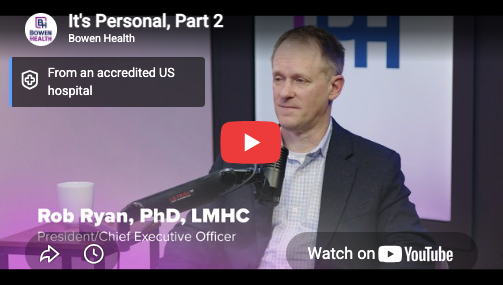
In part two of this special two-part series, Dr. Rob Ryan and Tess Ottenweller explore what it means to remove barriers to care, build trusted healthcare relationships, and ensure people receive the right support at the right time. From navigating complex healthcare systems to creating a future focused on prevention, wellness, and whole-person care, this conversation offers an inspiring look at how Bowen Health is helping individuals, families, and communities thrive.
Whether you're looking for support for yourself, concerned about a loved one, or simply interested in the future of healthcare, this conversation offers practical insights and a hopeful perspective.
Watch the video on our YouTube channel, listen to the audio-only version on your preferred platform, or read the episode transcript below!
Vodcast
Audio
Transcript
-
Transcript
00:00:06 Speaker 1
Welcome to the Bowen Health Podcast, where we talk about real life, real health, and what it means to take care of your whole self.
00:00:12 Speaker 1
I'm Tess Ottenweller, Vice President of Intensive Services at Bowen Health, and I am excited to have part two of a discussion with our president and CEO, Dr.
00:00:22 Speaker 1
Rob Ryan.
00:00:24 Speaker 1
So, Dr.
00:00:25 Speaker 1
Ryan, thank you for joining me again for part two of episode one.
00:00:30 Speaker 1
One of the things that I want to start talking about, we had a lot of good conversation if you tuned in for the first part.
00:00:37 Speaker 1
If you didn't, you can go back and take a listen.
00:00:39 Speaker 1
But we talked a lot about what Bowen Health is doing to treat the whole body and how important that mind-body connection is.
00:00:47 Speaker 1
One of the things that I want to talk about is many times people think of Bowen Health and they think mental health services or psychiatric care.
00:00:54 Speaker 1
And while that is such an important piece of what we do, it is not
00:00:59 Speaker 1
It's not the whole picture.
00:01:00 Speaker 1
It's one piece of the whole picture.
00:01:02 Speaker 1
So let's talk about what is it that Bowen Health does.
00:01:06 Speaker 2
Yeah, great, great question.
00:01:09 Speaker 2
So if you're an employee of ours, I think you would be saying over the last several years, we've really been pushing this side of the organization.
00:01:17 Speaker 2
It's not because it's more important.
00:01:19 Speaker 2
It's because a major role that we have as leaders here is getting the message out to the community.
00:01:25 Speaker 2
Because I think you're right.
00:01:26 Speaker 2
I mean, I've been out places and people will ask me, bone center?
00:01:30 Speaker 2
And, you know, being in Kosciusko, I guess they think maybe it's orthopedics or something.
00:01:35 Speaker 2
So our name change, even moving our outpatient locations in our core counties to places where healthcare happens,
00:01:44 Speaker 2
were an attempt to get people to see we do more than that.
00:01:48 Speaker 2
It was in no way to diminish mental health.
00:01:50 Speaker 2
It was really a saying, if you come here, we can take care of all of these things.
00:01:55 Speaker 2
Now, we don't plan on having cardiologists.
00:01:58 Speaker 2
We don't plan on having orthopedics.
00:02:00 Speaker 2
When we say take care of it all, it means when you leave our sphere, you don't leave our sphere of influence.
00:02:07 Speaker 2
We'll
00:02:08 Speaker 2
go with you.
00:02:08 Speaker 2
We have partnerships.
00:02:10 Speaker 2
We work with the local health systems.
00:02:12 Speaker 2
Mental illness and substance use remains our primary focus.
00:02:17 Speaker 2
But if we're going to take care of that, you know, challenge that people with serious mental illness have, which is again, sort of the erosion of quality years of life at the end of their life, they need someone to partner with them when they go out to these things.
00:02:33 Speaker 2
It's one thing to
00:02:36 Speaker 2
to be a father myself with two daughters, to be able to take time off from work, to go with them to an appointment, to hear what the doctor has to say, to go fill the prescription, to follow up with that care at home, and then to go back again in order to make sure that this episode of care is finished.
00:02:56 Speaker 2
I've been a single dad for a while.
00:02:58 Speaker 2
I know what it's like when you're drawn in two different places.
00:03:01 Speaker 2
You can't be in two places at one time.
00:03:04 Speaker 2
You're on the phone while you're in with the doctor.
00:03:07 Speaker 2
They're trying to get your attention.
00:03:10 Speaker 2
You don't have time immediately to go to the pharmacy when you do go.
00:03:14 Speaker 2
Maybe the script isn't ready.
00:03:17 Speaker 2
There is an understanding that the longer that I've done this job, that the idea that people can just navigate this complex healthcare system is
00:03:27 Speaker 2
part of the problem.
00:03:28 Speaker 2
And so something that we really want to do by emphasizing physical health, both in the knowledge of our staff, but also on the relationships we have in the community, is to make sure that people feel as though they have a partner.
00:03:42 Speaker 2
If you got sent for your A1C to be tested,
00:03:47 Speaker 2
We want to make sure, where is that easiest for you?
00:03:49 Speaker 2
Here's the places we work well with.
00:03:51 Speaker 2
Did you get that next time you come back?
00:03:53 Speaker 2
You didn't.
00:03:53 Speaker 2
How can I help you with that?
00:03:55 Speaker 2
You did.
00:03:56 Speaker 2
Did you understand what those results were when you went to go see your doctor?
00:04:00 Speaker 2
The doctor says to you, this is you're pre-diabetic.
00:04:03 Speaker 2
You come to see me afterwards as a psychologist.
00:04:06 Speaker 2
I'm, you might say, well, what can you help?
00:04:09 Speaker 2
Did you ask all the questions you had?
00:04:12 Speaker 2
You didn't?
00:04:13 Speaker 2
What happened?
00:04:13 Speaker 2
I was intimidated.
00:04:14 Speaker 2
I was scared.
00:04:15 Speaker 2
All I heard was, my father died from diabetes, so I'm nervous to have diabetes.
00:04:21 Speaker 2
Okay, let's practice next time you go to see that doctor.
00:04:25 Speaker 2
All right, let's see.
00:04:26 Speaker 2
What are the types of questions you'd like to ask?
00:04:28 Speaker 2
All right, I'll play the role of the doctor, and why don't you practice asking those questions?
00:04:34 Speaker 2
Next time when you come back and they're asking you to change some of your lifestyle things, let's work on that together and we'll help you with some motivation and ways to wrap your head around doing things to help you be successful.
00:04:47 Speaker 2
So I think that the idea about being total health is not meant to imply we'll do every specialty everywhere.
00:04:54 Speaker 2
but it's the idea to have a health relationship with you, that we will go with you no matter where you go.
00:05:00 Speaker 2
And something near and dear to my heart, back to that 20-year-old we talked about earlier, that will live a full life, it's to prevent or to push as late as possible, if it's genetics, the things that will become chronic diseases, because it's so much easier
00:05:17 Speaker 2
to manage and avoid than it is to treat and delay.
00:05:22 Speaker 2
And I think that that's really one of those ideas is that over the years watching and that you and I worked where we didn't have primary care, it went something like this.
00:05:32 Speaker 2
I'm gonna send you to see your doctor.
00:05:34 Speaker 2
It doesn't sound like you've been there for a long time.
00:05:36 Speaker 2
Please make sure you go.
00:05:38 Speaker 2
They come back for the next session.
00:05:40 Speaker 2
Did you go to your doctor?
00:05:41 Speaker 2
I didn't.
00:05:42 Speaker 2
Let me see if I can get her on the phone.
00:05:44 Speaker 2
try to call, they're in with another patient.
00:05:46 Speaker 2
We really need to get this done.
00:05:48 Speaker 2
And then life happens.
00:05:50 Speaker 2
The ability, like you said earlier, to walk down the hallway and say, this is Margaret.
00:05:55 Speaker 2
I've been meeting with Margaret and she was confused last time when she was here to see you and she was nervous.
00:06:02 Speaker 2
We've been practicing on what to say next time.
00:06:05 Speaker 2
Do you have time to answer a few questions now with me here?
00:06:08 Speaker 2
And I've literally had those hallway conversations that next time Margaret doesn't need me because she saw how her doctor was understanding and would take the time.
00:06:19 Speaker 2
And again, I just go back to the sense of pride in us moving and changing what we offer and how we offer it to meet today's community needs.
00:06:29 Speaker 2
It wasn't that Bowen was wrong.
00:06:31 Speaker 2
It's just we're meeting today's needs with the resources we have.
00:06:35 Speaker 2
So again, if I was talking to future Bowen,
00:06:38 Speaker 2
I don't even know where we're going to go, but I know we're going to go and meet the needs of whatever the community has at that time.
00:06:45 Speaker 2
And that's something that I think you and I are proud to pass along to the next generation.
00:06:50 Speaker 1
Oh my gosh, yes.
00:06:51 Speaker 1
And I, when you were talking, I just kept thinking in the crisis continuum that we have, you know, we talk a lot about new wrong door.
00:07:00 Speaker 1
So any door is the right door.
00:07:02 Speaker 1
Just come in a door.
00:07:05 Speaker 1
So what I love most, I think seeing our system
00:07:08 Speaker 1
in action is if someone comes in for any appointment, maybe that's the right appointment, maybe that's not what they exactly need in that moment.
00:07:16 Speaker 1
We're going to connect them to whatever service, whatever need they have, we're going to meet that need for them.
00:07:22 Speaker 1
So I get so excited about this robust continuum, which we've always had a robust psychiatric continuum, but now adding in all these additional physical health services has been just a game changer.
00:07:34 Speaker 1
So as you're talking about the
00:07:37 Speaker 1
robust continuum that we have here at Bowen Health.
00:07:40 Speaker 1
Talk to us a little bit about how that's appropriate for chronic conditions or for short episodic conditions that we have.
00:07:47 Speaker 2
Yeah, I mean, the way that I described our continuum, you might say to yourself, well, that's not me.
00:07:50 Speaker 2
I'm 30 years old and I don't have diabetes.
00:07:53 Speaker 2
Yeah, my dad or mom had diabetes, but you know, that's 20 years away.
00:07:59 Speaker 2
The idea really is, that the system meets the person where they're at.
00:08:06 Speaker 2
If I would be talking to patients of ours, it's the idea of I'm going to create a trusting relationship, working on what you brought today, preparing you to be an educated patient who's activated, who is energized over wanting to take care of their health in their long-term.
00:08:27 Speaker 2
I mentioned earlier, maybe there are things in your life that says, I need to figure out what I'm having for supper.
00:08:32 Speaker 2
That's important to me too.
00:08:34 Speaker 2
And I acknowledge that
00:08:37 Speaker 2
the fact that maybe you use tobacco is a check you're writing for yourself in 10 to 20 years.
00:08:42 Speaker 2
We got to get you to the 10 or 20 years.
00:08:44 Speaker 2
And the idea about really meeting people where they're at and helping them along is as I solve health problems with them, the immediate ones that brought them there, they're much more open to hearing, you know what, maybe I will take a look at, you know, my tobacco use.
00:09:02 Speaker 2
And, you know, years have passed, maybe it's like, all right,
00:09:06 Speaker 2
It's quit it.
00:09:07 Speaker 2
Just quit it.
00:09:08 Speaker 2
Maybe we're going to work from a pack a day to half a pack a day.
00:09:11 Speaker 2
And then we're going to work on something else.
00:09:14 Speaker 2
And then later, when that stabilizes, we're going to come back.
00:09:16 Speaker 2
I go back to, again, if you watched that first part of our podcast, we need to apply what we know about motivation.
00:09:23 Speaker 2
Asking a person to just stop it when it's been absorbed into their lifestyle, whatever those health choices are, is a lot.
00:09:32 Speaker 2
And so how you get to those higher order things that really are writing checks for 10 or 20 years from now is I have to build a trusting relationship with you.
00:09:41 Speaker 2
And trust is built on making successful, you know, adventures with you in health.
00:09:48 Speaker 2
And then later it's like, you know what?
00:09:51 Speaker 2
I think I will talk to you a little bit about diabetes in my family.
00:09:56 Speaker 2
Because last time I went, my numbers were a little bit messed up.
00:10:00 Speaker 2
And by then, we'll have also talked about housing and employment and chaos in the family and the challenges at school and all these other things so that we can create the space to talk about the bigger issues that are going to impact you in 20 years.
00:10:19 Speaker 2
Early in my career, there were times where I probably pushed and wanted to work on things too early and then wondered
00:10:26 Speaker 2
why didn't they stay?
00:10:27 Speaker 2
Or I wonder how that person did.
00:10:29 Speaker 2
I think, again, our clinicians of today with their training, both before they came to us and what they get at Bowen, are so much better prepared for meeting a person where they're at, leveraging where they are in their motivation, helping them understand what it would take to change.
00:10:48 Speaker 2
So for me, this idea about bringing physical health in, dentistry, having pharmacies in there,
00:10:54 Speaker 2
I think before, if we'd have done it before now, the system wasn't ready.
00:10:58 Speaker 2
I don't know that our training was ready.
00:11:00 Speaker 2
So over the last five years, I've really just been proud of the fact that our system was ready for it.
00:11:07 Speaker 2
And now really we're taking that next step in care, not just having multiple disciplines together in one place,
00:11:14 Speaker 2
But how do we all work together for the betterment of that patient?
00:11:19 Speaker 2
And that's something I'm excited to further transform with Bowen.
00:11:23 Speaker 2
And this idea about no matter where you go, no matter which clinician you see, no matter what door you come in, no matter what you want to work on, we are there for you.
00:11:32 Speaker 2
And we want to create a long-term health relationship that will allow you to focus on those things and then live that full life that you deserve.
00:11:41 Speaker 1
So I'm thinking about our incredible staff.
00:11:43 Speaker 1
We probably have a lot of staff that might be listening today and maybe professionally or personally.
00:11:50 Speaker 1
And I think about how important it is for our staff to be able to explain some of these concepts to the people that we're working with.
00:11:57 Speaker 1
So
00:12:00 Speaker 1
integrated care, whole person care.
00:12:02 Speaker 1
Sometimes those terms, while some of us may know what they mean, they can feel really abstract.
00:12:08 Speaker 1
So how would we like our clinicians, our staff, or even community members to talk about what those things are?
00:12:16 Speaker 2
Yeah, so I was sitting there thinking to myself, man, even me, if you had to come and talk to me 10 years ago, what would I have figured out?
00:12:23 Speaker 2
I usually try to start from this standpoint.
00:12:25 Speaker 2
If you and I were asked to come into our kids' classroom and it is career day and you had to explain what you did, I don't think I'd use the word integrative care, right?
00:12:35 Speaker 2
I would almost tell you that immigrative care or whole person is almost internal speak.
00:12:42 Speaker 2
When I'm thinking about I'm in front of a fifth grade class and I'm talking about what I do, I would want to tell them in the class,
00:12:49 Speaker 2
I work for a place that takes care of people's health and that they can come to us no matter what it is that they're dealing with, and we help them find a way to meet their goals.
00:13:00 Speaker 2
And if they go, well, what does that mean?
00:13:02 Speaker 2
Is I say they come in sick and they leave well.
00:13:06 Speaker 2
And I think that for me, this idea about integrative care is multi-specialty working together for the good of the patient so that they come in sick and they leave better.
00:13:19 Speaker 2
I wish I would say everyone was well, but depending on where people are in life, at least they've moved the dial from where they're at to where they went.
00:13:27 Speaker 2
If you ask me, what is the number one thing you hope for when patients leave and tell their friends about us, is that they would say, go there, they care about you, and I got better.
00:13:38 Speaker 2
I mean, without that, what are we doing?
00:13:41 Speaker 2
If I was in a position and early in my career at Bowen, I didn't think I was making a difference, I wouldn't have stayed.
00:13:48 Speaker 2
And I really hope that people today feel that, the idea is, we don't just have a psychiatrist down the hallway like you and I had.
00:13:57 Speaker 2
They were like, I have multiple people down there that will help you within our system, and if you have to go outside of our system.
00:14:04 Speaker 2
The idea that people fall through the cracks is a thing that is just passed around like so easily, but that's really what used to happen in our world.
00:14:12 Speaker 2
Expecting a person who's challenged with their own personal safety today, their own livelihood, or where am I going to sleep, expecting them to go to a giant hospital system to get an MRI done, to find some obscure thing that hurts in their stomach.
00:14:29 Speaker 2
You're like, well, next time they come back, did you go get that done?
00:14:31 Speaker 2
I didn't.
00:14:32 Speaker 2
What are you going to scold them?
00:14:33 Speaker 2
Why didn't you?
00:14:34 Speaker 2
Well, the shelter didn't open till five.
00:14:40 Speaker 2
And if you're not there between 5:00 and 530, you can't get a bed.
00:14:44 Speaker 2
And the only time that the hospital had for my MRI was at 445.
00:14:50 Speaker 2
Not only would I not fault them, how do we leave them in that situation?
00:14:54 Speaker 2
And so to me, the bigger issue is
00:14:57 Speaker 2
How can we solve all these issues?
00:15:00 Speaker 2
Some of them seem insurmountable.
00:15:01 Speaker 2
Some of them seem so big.
00:15:02 Speaker 2
Some of them people have been dealing with for a decade or more of their life.
00:15:07 Speaker 2
But we finally have a place that says integrative care means we're going to work on whatever it is that is impeding you from living your life as you define, you know, being healthy in that moment.
00:15:19 Speaker 2
It's not pushy.
00:15:21 Speaker 2
It's not, yeah, but what about the tobacco usage?
00:15:25 Speaker 2
It really is.
00:15:26 Speaker 2
what can I do to help you today?
00:15:28 Speaker 2
I think that's really been powerful for me and why I've stayed at Bowen is we meet people where they're at.
00:15:34 Speaker 2
And integrative care is you come in sick and you leave well.
00:15:41 Speaker 2
I said earlier, I wonder where we'd be if I had a dream.
00:15:45 Speaker 2
It's that much like people with physical health, they go get annual wellness visits.
00:15:51 Speaker 2
I would love to be able to say, well, people come in
00:15:55 Speaker 2
and they stay well.
00:15:57 Speaker 2
I think so often when it comes to mental illness, we wait so long before we get help that it's nearly a crisis.
00:16:05 Speaker 2
And so if I have a dream for our future, when today, and they're in these leadership places, is that prevention, the idea of I go to see someone to stay well, I create a relationship, like an annual wellness visit is something we do.
00:16:19 Speaker 2
either specifically for mental illness or it's included in that annual wellness visit is sort of, to me, the next iteration of you don't need to get sick in the 1st place.
00:16:28 Speaker 2
So that's to me, if you're like, what are you excited about?
00:16:31 Speaker 2
It's that idea about keeping people well as long as possible.
00:16:35 Speaker 1
Oh my gosh, yeah.
00:16:36 Speaker 1
It reminds me of, you know, we talk a lot about the right support at the right time.
00:16:40 Speaker 2
Oh, totally.
00:16:42 Speaker 1
One other thing that you hit on that I think we all as human beings,
00:16:47 Speaker 1
can really create confusion is using language that's really difficult.
00:16:56 Speaker 1
Using language that are acronyms that not everyone knows, using language, words that people might not have a shared definition for.
00:17:04 Speaker 1
And I know that we've been working really hard at making sure we're using language, but just like integrated care and being able to spell that out in regular terminology for people to really understand what are some other insights
00:17:17 Speaker 1
Instances, that we have some really great things going on, but we might not know how to explain it.
00:17:23 Speaker 2
Yeah, oh man, I'm trying to think about a good analogy, so...
00:17:27 Speaker 2
I don't know that I'd call myself a theater kid, but I was Charlie Brown in the 7th grade school play.
00:17:35 Speaker 2
And there's something from theater that they talk about is it's sort of like on stage and off stage.
00:17:41 Speaker 2
I think much like I said earlier, if I went to a fifth grade class, I need to know my audience and make sure that I'm speaking that way.
00:17:49 Speaker 2
If I use
00:17:50 Speaker 2
offstage conversations with those individuals, those would be things like theater kids, the lighting, all these words that we all know because we're in the theater business every day.
00:17:59 Speaker 2
Everyone looks at us like, I have no idea what you're talking about.
00:18:02 Speaker 2
So the idea about onstage and offstage really matters.
00:18:05 Speaker 2
I think when it comes to even offstage, let's just start there.
00:18:08 Speaker 2
This would be like for us and our staff and our industry, even there, I think it's worthwhile having shared words, shared language.
00:18:19 Speaker 2
If I say crisis, you say crisis, what does that mean?
00:18:22 Speaker 2
if I have a diagnosis and you have a diagnosis, it needs to really match.
00:18:28 Speaker 2
So for me, if we start with the offstage stuff, the thing that happens behind the scenes, having a shared language matters.
00:18:36 Speaker 2
It means that it doesn't matter which lighting guy or gal is there.
00:18:41 Speaker 2
You know that when you go on stage, the lights are going to come on and it's going to be there.
00:18:45 Speaker 2
So starting with that offstage, we just
00:18:49 Speaker 2
redid some of our five-year strategic plan and added, not just focusing on mind and body to live a longer, healthier life, we included this idea about chronic care management.
00:19:00 Speaker 2
And that's off-stage talk.
00:19:02 Speaker 2
Off-stage talk for an evidence-based practice.
00:19:05 Speaker 2
It's a philosophy and a system that is going to take integrative care as we understand it today, where I would argue
00:19:13 Speaker 2
If you go to the right place, the right clinician at the right time, call the right person, we do excellent work.
00:19:18 Speaker 2
But how do we know for sure it's gonna happen in county X, getting county, you know, the service Y?
00:19:25 Speaker 2
Chronic care model focuses on 6 broad areas that systematically improves the way that we interact with.
00:19:34 Speaker 2
There are things like how our health system itself and leadership views the system.
00:19:40 Speaker 2
It includes how we interact with the community, who's our partners.
00:19:44 Speaker 2
When we send somebody, I said earlier, we send them to a health system, you make partnerships with places that you know will get you that information back, will handle our patients with respect, and make sure that when they're finished, they send us that information back.
00:20:00 Speaker 2
It's also a systematic way of making sure patients understand what's their responsibility in treatment.
00:20:06 Speaker 2
You know, the idea about self-management and finding ways to make sure that a patient knows, here's what you need to accomplish.
00:20:13 Speaker 2
Then it comes to the decisions that we make, things like what evidence-based practices do we use, and then also even just how we get information back to clinicians.
00:20:24 Speaker 2
You come to see me, and before you come in, I know that last time I sent you to make sure you got your wellness visit, and I see that it wasn't finished, and I'm going to make sure I have a conversation with you.
00:20:35 Speaker 2
Our clinicians have so much to do.
00:20:37 Speaker 2
You got to make it easy to make sure that, Tess, it's great to see you.
00:20:41 Speaker 2
I'm so glad.
00:20:44 Speaker 2
I don't see that I got the information back from your wellness visit.
00:20:47 Speaker 2
Were you able to get to that?
00:20:49 Speaker 2
I wasn't.
00:20:50 Speaker 2
I couldn't.
00:20:51 Speaker 2
Okay, well,
00:20:53 Speaker 2
Let's set that aside.
00:20:54 Speaker 2
If we have time, let's talk about that and make sure if you add any barriers that we can take care of that.
00:21:00 Speaker 2
And then also, even just internally, again, offstage talk is our IT system is able to get information back to clinicians in order to look at a population health level.
00:21:12 Speaker 2
It's not just important on an individual level.
00:21:14 Speaker 2
Did a person have their A1C?
00:21:16 Speaker 2
Did they go to their annual wellness visit?
00:21:19 Speaker 2
Did they have a colonoscopy?
00:21:21 Speaker 2
It's what about the 10,000 people who are over the age of 50 that need to get that colonoscopy?
00:21:27 Speaker 2
Are we doing a good job with that or not?
00:21:30 Speaker 2
So that's off stage.
00:21:31 Speaker 2
Now on stage, I am always trying to push myself to remember, all right, if you're in front of a fifth grade class, you're talking in fifth grade class language.
00:21:42 Speaker 2
For me, it's just a reminder of, we do this every day.
00:21:46 Speaker 2
We use acronyms.
00:21:48 Speaker 2
simplifying things, making sure we check with people.
00:21:52 Speaker 2
Did you understand that?
00:21:54 Speaker 2
At the end of a session, using that collaborative documentation moment to say, did we miss anything today?
00:22:01 Speaker 2
What did you hear us talk about today?
00:22:03 Speaker 2
Are there things you're excited about doing this week?
00:22:06 Speaker 2
Making sure that people understand is one of the key ways in active listening that you can make sure that you didn't let off-stage language slip
00:22:17 Speaker 2
when you went on stage.
00:22:18 Speaker 2
You can just imagine if you went on stage and it's a play and you started talking in ways that people in the audience don't understand, they're going to be like, that was a terrible play.
00:22:26 Speaker 2
I'm not going to tell my friends to go.
00:22:28 Speaker 2
But if you spoke in a way that you understood and that story that they're telling is compelling and it's something that had you engaged,
00:22:36 Speaker 2
you're going to leave that play and you're going to be like, you got to go see Charlie Brown, Rob Ryan, 7th grade, best Charlie Brown I've ever seen in my life.
00:22:43 Speaker 1
We're going to fact get that.
00:22:46 Speaker 2
That's right.
00:22:47 Speaker 2
I hope there's no video.
00:22:50 Speaker 1
Yeah, well, what we do is complex.
00:22:52 Speaker 1
So I think hearing messages like that, how to explain things, how to break things down, how to make sure we have a shared definition and language is really important.
00:23:00 Speaker 1
So that's great to hear those things.
00:23:03 Speaker 1
So
00:23:04 Speaker 1
What gives you hope right now in the world of healthcare?
00:23:09 Speaker 2
I love that question because I feel as though if you spend time, what are they, you're just scrolling on social media, it's almost like people in the world wants you to be upset or frustrated or stand for something.
00:23:25 Speaker 2
And I have come to realize that in our leadership positions, that we represent the voice of our community,
00:23:34 Speaker 2
the voice of our staff and the voice of our patients.
00:23:38 Speaker 2
And I've been in rooms with powerful people who are saying things that I just don't understand.
00:23:44 Speaker 2
And I'm in places where I think to myself, man, it's going to be hard to talk to that person.
00:23:48 Speaker 2
Is it worth it?
00:23:50 Speaker 2
And when you think to yourself, I'm here for them.
00:23:53 Speaker 2
They don't have a voice if I don't speak up.
00:23:55 Speaker 2
It's made it easy to step up and say, listen, this is hurting the people
00:24:00 Speaker 2
that we believe in, this is something you need to hear.
00:24:04 Speaker 2
So for me, that really is one of those pieces where I'm really proud of the fact that we use our position to make sure that we get our people's voices in front of individuals.
00:24:16 Speaker 2
So one of them, the idea about hope is more and more in those rooms, people want to hear about people's experiences with mental illness.
00:24:25 Speaker 2
I would say, here's a little name drop.
00:24:28 Speaker 2
Back in the day,
00:24:30 Speaker 2
Our representative of this area from nationally was Jackie Walorski, Representative Walorski.
00:24:37 Speaker 2
Unfortunately, she had passed away about two years ago in a tragic car accident.
00:24:41 Speaker 2
But early on in my leadership career here, when she would come to visit, she was like, help me understand how we send you this money and where is it spent and what is happening.
00:24:52 Speaker 2
And we would try our best to explain and we'd show spreadsheets and we'd do things.
00:24:57 Speaker 2
And about a year or two passed and
00:25:00 Speaker 2
Representative Wolorski called me and said, I want to meet with you.
00:25:05 Speaker 2
Got all those spreadsheets together.
00:25:07 Speaker 2
I got all those facts together to show her all the people that we're working with.
00:25:10 Speaker 2
And we got started in that meeting.
00:25:13 Speaker 2
And after about 5 minutes of here's the stat, she just stopped and said, I want to tell you something.
00:25:18 Speaker 2
And I said, yes.
00:25:19 Speaker 2
And she said, a family member of mine needed help.
00:25:25 Speaker 2
And I just picked up the phone and called your 1800 number.
00:25:28 Speaker 2
I didn't call you.
00:25:29 Speaker 2
and they got helped.
00:25:30 Speaker 2
And I want to tell you that you saved their life.
00:25:33 Speaker 2
What can I do to help you?
00:25:35 Speaker 2
And I think that for us in our world today to know that Rudy Yakam, who is a replacement, same attitude, how can I help?
00:25:43 Speaker 2
Understanding that when someone has someone in their own life, it moves it from a spreadsheet or from numbers to this idea that says you're here to help people, help them live their best life, help them to keep them alive.
00:25:56 Speaker 2
I have to say in our world, there's so much
00:26:00 Speaker 2
politicians or leaders, they really do want to know and help.
00:26:04 Speaker 2
And I think more than ever, there's a sense and understanding like us that people with mental illness not only deserve to live a full life, but they have something to give to us in society, not be sent away, kept away, in some place where we don't have to see or hear them, but a sense of
00:26:22 Speaker 2
You know what?
00:26:23 Speaker 2
Their artistic contributions, their spiritual contributions, their love contributions, their work contributions are just as value as mine and yours.
00:26:35 Speaker 2
That should give people hope that when I'm in the room with those people, that's what they're talking about.
00:26:40 Speaker 2
If you look at social media or the news today, that's not what it seems like they're talking about, but they really do care.
00:26:46 Speaker 2
When I think about the hope for Bowen is
00:26:50 Speaker 2
I don't know about you, but I look at people coming up through the system, the talent they have, the training they have, the feedback they give us.
00:26:57 Speaker 2
And I'm just like, we are in good hands in the future.
00:27:01 Speaker 2
The leadership we have that is shown in every position, I mean, it's yes, in leadership positions, but people who will stand up when we come out and talk and ask questions that I probably would have never asked, you know, I'm nervous and it was it.
00:27:15 Speaker 2
People now will just say, did you know this is happening in our office?
00:27:18 Speaker 2
What are you going to do about it?
00:27:19 Speaker 2
is a sense that we're in good hands in the future.
00:27:22 Speaker 2
To be able to hand Bowen to them and to see where they can take it gives me hope.
00:27:28 Speaker 2
And then, you know, the final thing for me, the hope with Bowen is I've been here long enough now to have gone through the system and experienced times where I'm frustrated.
00:27:38 Speaker 2
Why'd they make that decision?
00:27:39 Speaker 2
I mean, you and I have had conversations before we're in leaders positions just literally like, that's so dumb.
00:27:44 Speaker 2
Yeah.
00:27:45 Speaker 2
And then when you get into those positions where you can affect change, there are certain aspects where probably, I probably can think of 1 with you where you circle back around and go, oh, I understand that a little better.
00:27:58 Speaker 2
I didn't know that about, I didn't know how complex this issue was.
00:28:00 Speaker 2
I didn't know that the state required this.
00:28:02 Speaker 2
I didn't know the federal government required that.
00:28:05 Speaker 2
But even still, the fact that Bowen
00:28:08 Speaker 2
allowed you and I to grow and to bring our ideas forward is something that I really believe in strongly, which is that idea about pay it forward.
00:28:16 Speaker 2
You and I owe the people who are coming behind us those same opportunities to listen, to let them have input, to help them shape the future of Bowen, to hear what the community is saying about us that works and the painful conversations about what doesn't work and get something prepared so that when we do turn it over,
00:28:36 Speaker 2
it's not really that big of a deal because they've all been having a say as we go.
00:28:40 Speaker 2
So to me, I look at our workforce that we have right now, and it is to me the finest workforce to deal with.
00:28:47 Speaker 2
As you'll often hear, there's a mental health crisis.
00:28:50 Speaker 2
True, but I don't know that we've ever been better prepared or that I have more faith in meeting our community's needs with the different services that we provide and the people in those jobs.
00:29:02 Speaker 2
I mean, honestly, I felt like I knew my stuff.
00:29:05 Speaker 2
I felt like you knew your stuff, but I'm like, they're light years ahead of where we were at their age.
00:29:10 Speaker 2
So I really just think hope wise, Bowen will continue and it will meet whatever needs the community has in the future.
00:29:18 Speaker 2
And I will be excited someday
00:29:21 Speaker 2
and when I look and be like, you're doing what?
00:29:24 Speaker 2
my word, that's so amazing.
00:29:26 Speaker 2
I never could have imagined that.
00:29:27 Speaker 2
And I know it will be to meet the community's needs with the primary emphasis being on the mental wellness of the communities.
00:29:36 Speaker 2
Just because we're added, you know, dentistry and primary care doesn't mean we're getting away from that mission.
00:29:42 Speaker 2
It's about helping to prop those people up and live a full life some.
00:29:47 Speaker 1
I was going to ask you a little bit about, we talked about a lot of great things and time seems to always run short.
00:29:54 Speaker 1
You gave some really great takeaways.
00:29:56 Speaker 1
Is there anything else that you'd like to end with as far as your hope that people take away from this conversation?
00:30:02 Speaker 2
I hope that the podcast is just another way to communicate something that's so important to me.
00:30:08 Speaker 2
Like I said, when we were coming up, one of the advantages we had was we were a smaller organization.
00:30:13 Speaker 2
Access to leaders was different.
00:30:16 Speaker 2
technology was different.
00:30:17 Speaker 2
And so for me, I really excited from a podcast standpoint just to go, I would have liked to have known that.
00:30:24 Speaker 2
And back in the day, we did know it because there was only 250 staff.
00:30:28 Speaker 2
And so you were around people more.
00:30:30 Speaker 2
So to me, I really hope that the podcast is an Ave.
00:30:33 Speaker 2
for people to hear what we're doing, to be excited what we're doing, meet some of our leaders and our staff and
00:30:42 Speaker 2
to see a different side of them and to say, I have that same hope that I do, which is Bowen is in great hands.
00:30:49 Speaker 2
We are going to move forward and we are going to be there for the community in the future.
00:30:53 Speaker 1
So Dr.
00:30:54 Speaker 1
Ryan, what does this mean for the real person who's out there and maybe saw a billboard, maybe heard about Bowen Health, maybe isn't sure if their problem's big enough to come in?
00:31:06 Speaker 1
What's your message to them?
00:31:08 Speaker 1
How do they get connected?
00:31:09 Speaker 1
How do they fit into Bowen Health?
00:31:11 Speaker 2
I guess I'd look and say, if you're listening to this podcast or if you're doing one of those things, I guess the deal is we've tried really hard over the last 10 years to reduce the three major reasons why people weren't getting services.
00:31:24 Speaker 2
The cost, the stigma, and they just didn't know we existed.
00:31:29 Speaker 2
We will provide care regardless of your ability to pay.
00:31:32 Speaker 2
The stigma, we worked hard to lower that by saying, hey, look, we have all these different services.
00:31:37 Speaker 2
No one will know why you're there.
00:31:39 Speaker 2
And then the other version is,
00:31:41 Speaker 2
We changed our name to make sure that people understood who we were better.
00:31:45 Speaker 2
So when we say pick up the phone, don't worry what it costs.
00:31:49 Speaker 2
Don't worry about how it looks.
00:31:51 Speaker 2
We're here to help you.
00:31:52 Speaker 2
And now that you know that, call us and we want to take that health journey with you.
00:31:57 Speaker 1
So people might be surprised to hear that because they're not sure who Bowen Health is for.
00:32:01 Speaker 1
So who would you say Bowen Health is for?
00:32:04 Speaker 2
Yeah, again, if I were to take that 10,000 foot view, if you're on shore,
00:32:10 Speaker 2
If you're the way you're feeling is normal, if you're unsure, if you can deal with the daily challenges in front of you, then we're for you and we can help to solidify that.
00:32:21 Speaker 2
If you're someone that you have in your family that they're starting to act in some way that is concerning you, it's something that you believe this could be mentally ill-related, substance use, come reach out.
00:32:34 Speaker 2
All it takes is an assessment.
00:32:35 Speaker 2
Could be, may not be,
00:32:37 Speaker 2
And then finally, the other piece is, maybe you just dip your toes and say, what?
00:32:41 Speaker 2
I haven't been to a dentist in a while and come check out our dentist and maybe just figure it out that way and say, I'm just going to do that first.
00:32:48 Speaker 2
It really doesn't matter.
00:32:49 Speaker 2
I think just starting the health relationship is 1 where you can build trust.
00:32:54 Speaker 2
And that our goal is that 20 something lives a full life and we prevent many of the challenges that are things that chip away many years from people's lives.
00:33:03 Speaker 1
So we might have individuals who are like, okay, you know what?
00:33:06 Speaker 1
I am going to pick up the phone.
00:33:07 Speaker 1
I am going to make an appointment.
00:33:08 Speaker 1
Let's see what happens.
00:33:10 Speaker 1
But you hit on something important, family.
00:33:12 Speaker 1
What if you have someone you love that you think might need to seek services or you might need some support services, but you don't really realize that.
00:33:22 Speaker 1
So
00:33:23 Speaker 1
How does a family member seek care?
00:33:25 Speaker 2
Great question.
00:33:26 Speaker 2
Like any healthcare, there are limits to what we can do in terms of, you can't really bring in your spouse and be like, she has a problem.
00:33:35 Speaker 2
He has a problem.
00:33:37 Speaker 2
I, in many of my early clinical work, I worked with children and often parents would come in and say, I don't know what to do.
00:33:44 Speaker 2
Fix them.
00:33:45 Speaker 2
And the very first thing you say is not,
00:33:48 Speaker 2
It's a family systems problem.
00:33:50 Speaker 2
It's talk to me about it.
00:33:51 Speaker 2
You create a relationship.
00:33:53 Speaker 2
So for me, let's say, for example, you do have someone in your family.
00:33:56 Speaker 2
The greatest message you can send to someone in your family is to be open to those things yourself.
00:34:02 Speaker 2
My guess is it's disturbing you and concerning you.
00:34:07 Speaker 2
come in and see us.
00:34:08 Speaker 2
If you come in and see us and have a great relationship, there's no more powerful message to a loved one that I went and it made a difference for me.
00:34:16 Speaker 2
And so I think that's the most important thing is, come in.
00:34:20 Speaker 2
And then you can tell them, this is what the experience was.
00:34:23 Speaker 2
In a situation like that, it's great to have someone that you can run those questions by.
00:34:27 Speaker 2
And in those individual circumstances, I guarantee you they will make that the priority and you'll come up with a great way to introduce the idea of help to that other person.
00:34:38 Speaker 1
That's fantastic.
00:34:39 Speaker 1
Thank you, Dr.
00:34:40 Speaker 1
Ryan.
00:34:40 Speaker 1
And thank you all for listening and tuning in.
00:34:43 Speaker 1
We really appreciated having this conversation with you.
00:34:45 Speaker 1
Until next time.
Share this Podcast!