

What Therapy is Really Like: Support for the Journey, Care for the Whole Person, Part 1
What therapy is really like may surprise you.
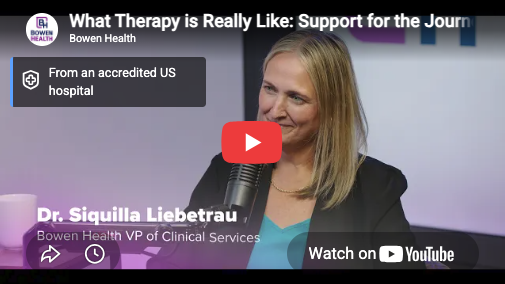
In Part 1 of this powerful two-part series, Bowen Health's Tess Ottenweller sits down with Dr. Sequilla Liebetrau to break down common myths about therapy and explore what actually happens when you take that first step toward support. From individual and family therapy to virtual options and whole-person care, you'll learn how therapy can help you navigate life's challenges, build resilience, and move forward with confidence.
Whether you're facing a major life transition, feeling stuck, supporting a loved one, or simply looking for a healthier way to cope with everyday stress, this conversation is a reminder that you don't have to do it alone. Help isn't just for times of crisis. It can be a powerful tool for growth, healing, and living well. Join us for an honest look at what therapy is really like and how the right support can make all the difference.
Watch the video on our YouTube channel, listen to the audio-only version on your preferred platform, or read the episode transcript below!
Vodcast
Audio
Transcript
-
Transcript
0:06
Welcome to the Bowen Health Podcast, where we talk about real life, real health, and what it means to take care of your whole self.
0:13
I'm Tess Ottenweiler, Vice President of Intensive Services here at Bowen Health, and today we're kicking off a two-part episode focused on therapy.
0:22
In this first part, we're going to talk about individual and family therapy, what therapy really is, who it's for, and how it can help people navigate life's challenges.
0:31
Then in Part 2, we'll dive into group therapy and explore the unique power of healing and growth alongside others.
0:38
I am very excited today to be joined by Doctor Sequilla Liebetrau, our Vice President of Clinical Services.
0:44
Doctor Liebetrau, thank you for joining us.
0:47
And before we get started, I'd really like to kick it over to you so you can give us an introduction about who you bar and why you do what you do.
0:54
Oh my gosh, thank you for having me.
0:56
I'm really excited that we get to talk about this today.
0:59
My profession is that I am a licensed clinical psychologist by trade, and I've always just been really passionate about community mental health and serving people that might otherwise fall through the cracks, that don't get that quality healthcare experience that we all deserve.
1:22
And so that that's my entire career just been very important to me At Bowen Health, I kind of oversee all the clinical practices.
1:30
So making sure that we have good quality care for patients, that we integrate our care.
1:36
And maybe we'll dive into that a little bit more today as well.
1:40
And that we have a good model to follow.
1:43
We follow the chronic care model, which may to the average person not necessarily mean anything or ring a bell, but for us that truly means that we want to care for the patient for any small event in their life.
1:58
But also sometimes we have chronic conditions that feel very heavy to have to carry by yourself.
2:05
And so knowing that there is a team that can support you and help you on the hard days that celebrate the good days that that's just they're always, they're kind of your medical home that can help you navigate the difficult.
2:23
I love that idea and I'm just really passionate about that.
2:26
Awesome.
2:26
Well, I'm thrilled that you're here.
2:28
I have learned so much from you over the years.
2:30
So I want to take it back to the basics and start with therapy.
2:36
So what exactly is therapy?
2:39
Oh my gosh, not what you see on TV.
2:42
I feel like we get all the worst examples on TV of what therapy is.
2:47
They usually make all these terrible ethical violations.
2:52
So really going back to basics, what I love about therapy is that it is a safe space.
3:00
It is a space where you can process through things that you've been struggling with.
3:07
So whether it's something that you've been caring for a really long time or maybe it's something newer in your life, it's impacting your ability to function.
3:19
You just don't quite feel yourself.
3:22
It's a safe space and that process is guided by a trained professional.
3:30
And that's the key.
3:31
I think that's, that's how it's different from maybe just chatting with your best friend or your mom or whoever that you get your advice from.
3:42
Often times people will say, well, it, it's, it's advice and my therapist is going to just tell me what to do.
3:50
Well, it it's not there be is a space where you get to decide, but you have a professional that helps you through that process.
4:00
They can teach you some skills along the way if it's maybe a matter of I just don't quite know how to do this thing or I'm really struggling with this anxiety or depression that the symptoms that go with it, they can help guide.
4:15
But you're in charge.
4:16
You're 100% in charge and you get to sort of like paint where you want to go with it.
4:26
I love that.
4:27
And I think you're right that a lot of people have this idea in their head about like I've seen on the movies, I'm laying on a couch and somebody's going to talk to me and tell me exactly what to do.
4:37
So I think that information is so helpful.
4:39
And what a, what a good definition for us to all kind of have in our heads about what therapy is.
4:44
It's not intimidating.
4:45
You are in the driver's seat.
4:46
I love all of those pieces.
4:48
Absolutely, 100% in control.
4:50
So one question I think that people also have about therapy is how long am I going to be in therapy?
4:56
That is a really good, great question.
4:59
And I can't tell you exactly how long because it really should be very much based on your needs.
5:07
And every, everybody is different.
5:09
It may be something a little bit smaller, maybe that you're just going through a life event right now and maybe a few sessions is all you need.
5:18
And for somebody else, there may be lifelong trauma that you're trying to get through in process and maybe you just need a little bit more time.
5:27
So we always like to develop the the course of treatment for you based on your needs.
5:34
So you might be good for one session, 2 sessions, three sessions.
5:39
We have modalities where we can do very brief intervention and then somebody else might say, no, I want to take my time with this process and we can do both.
5:50
So, so that's as far as how much time therapy will will spend.
5:56
But we can always play with other pieces too.
6:00
We can look at, do you want 30 minute sessions?
6:03
Do you want 45 minute sessions?
6:06
Do you want to visit with your therapist once a week or do you want to space it?
6:11
Do you want some time to think through things between sessions?
6:15
So do I want to see my therapist maybe once every three weeks or once a month?
6:21
It really should be.
6:22
Again, you're in charge.
6:23
You get to decide what works for me.
6:27
I love those options because that's what people want, right?
6:30
It's options.
6:31
Not everything works the same for everyone, including the time you spend.
6:35
So 30 minute sessions sounds so much better than old school 60 minute sessions that I've heard of before.
6:42
Or maybe we were trained in years ago, so that's really cool and innovative and and so helpful for people.
6:51
Now I'm thinking about someone who comes into therapy and has sessions and has a goal they're working towards, completes their goal and they stop therapy.
7:02
Yeah.
7:03
Can they come back?
7:05
Of course you can come back.
7:06
You can always come back again.
7:08
It's based on your needs.
7:10
And so sometimes people will even kind of linger in therapy for a while because they're like, this is so good.
7:15
And I feel like without my therapist, I'm not going to do good.
7:19
We really want you to be able to just kind of fly the coop a little bit and see how it goes.
7:26
So sometimes in therapy will even say, hey, how about we try a little break or a vacation from therapy?
7:32
How about you go do this for a month on your own, come back and tell us what worked, what didn't work, and we can tweak things a little bit and then we really send you off on your own.
7:43
And then if something else happens in your life, come back.
7:46
We are here for you.
7:48
But it's always your choice.
7:50
Come and go as it works for you.
7:53
I love that message.
7:55
OK, so we have to talk about accessibility.
7:57
I know you and I talk about accessibility a lot.
8:00
And we know that people are balancing work and school and parenting responsibilities and everything in between that life throws at them.
8:10
Are there options for people who can't come into the office?
8:14
Yes, yes, yes, yes.
8:16
I'm so excited.
8:17
We originally learned so much about virtual or telehealth treatment when COVID kind of forced us to go that route because we were serving patients that truly needed care, that wanted care.
8:33
COVID brought up so many different needs for people, so we needed to be able to just say, yes, we will serve.
8:39
We will take care of you.
8:43
We needed to figure out how to do that.
8:45
So we do.
8:46
Virtual people use different words for virtual care or telehealth care.
8:52
What that truly just means is it's like a video appointment where there's you hear your therapist and you see your therapist.
9:00
So you have both of those pieces at the same time.
9:04
And so it feels a little bit different at first because you're not sitting in the presence of your therapist, but you're able to access them the same.
9:14
So kind of once you sort of like shake off that, this feels a bit different.
9:18
It works exactly the same.
9:20
So you can have that virtual appointment and same options.
9:25
You can decide, especially again, you said people are busy, Absolutely so busy.
9:30
So you can say I want a 30 minute virtual appointment or I really want to space things because my life is so tight right now.
9:38
I want to do maybe 30 or 45 minute once every month.
9:44
Or if you need once a week, that's that's good too.
9:47
Or if you have a real crisis on your hands, we could do twice a week.
9:52
But the fact that there is the option available to do virtual, it also kind of cuts out, right?
9:58
You don't have to consider just the time for the appointment.
10:01
When you go in office, you kind of have to think how long is it going to take me to get there?
10:06
How long is it going to take me to come back?
10:08
What's the traffic going to look like?
10:11
Are is there road construction?
10:13
I have to get a babysitter.
10:15
So it can be just an incredibly convenient option for some folks.
10:22
Oh my gosh, yes.
10:24
So cool to be able to do that.
10:27
So let's say I'm planning on coming into the office and my transportation falls through and I don't have transportation that day.
10:36
Do I have to cancel my appointment or how hard is it to flip it to virtual?
10:41
Just let us know.
10:42
Just let us know.
10:43
Just let us know if you call into the office or you let your therapist know directly, we can flip that appointment pretty easily.
10:53
Now, the key obviously is to make sure that you have all the technological things on your end.
10:59
So sometimes it's helpful to just check in with your therapist kind of on the front end to say, hey, I'd love to be able to have the option to either do virtual all the time or maybe just sometimes.
11:10
What would that look like?
11:11
And your therapist can just kind of walk you through through they can show you, you know, here's where we'll see send you the link.
11:17
You can just click on it really easily.
11:19
So accessible.
11:21
I am not a tech wist.
11:22
I can do it.
11:24
Pretty much anybody could do it.
11:25
So it's very, very easy to access and your therapist can walk you through.
11:30
Awesome.
11:31
OK.
11:31
So I think sometimes people hear the term virtual therapy and they think it's something totally different.
11:37
So it's really nice to hear that it's not a different service.
11:40
It's just a different way to connect with your therapist.
11:43
You're sitting with your therapist, but you're in the comfort of your own home.
11:47
Maybe you can wear your P's or whatever is like is comfortable and and honestly for for some therapies and for some conditions, sometimes it is an easier way into therapy to start in the privacy of your own home.
12:04
You want to be able to access the therapist.
12:07
But maybe your condition is is so overwhelming.
12:10
I'm just thinking of some folks have anxiety and social settings so the thought of having to go check in at a front desk or the thought of having to sit in a crowded lobby might be too overwhelming.
12:23
Or maybe your depression has just been so hard that just getting up that day or just taking a shower that day already took so much out of you that the thought of having to drive, having to find parking is just too much.
12:39
So sometimes it could just be a great way to just take those first baby steps.
12:45
Yeah, yeah.
12:46
Oh, what a great point.
12:48
So one of my questions about virtual therapy is have you found it?
12:52
It can be just as effective for many people than in person therapy.
12:56
Absolutely.
12:57
Absolutely.
12:58
So I will say for some folks, it's not a great fit because we see sometimes 4 younger kiddos, for instance, it's a little bit harder to hold their attention.
13:10
They get distracted or if you're even as an adults, some of us just need to be in the room with the provider.
13:18
So sometimes you'll find, but we can always try it out.
13:21
You can say, hey, I just want to try a couple of sessions and see how it goes.
13:25
We can do that.
13:26
You don't have to make a commitment and say I'm going to do this, you know, the entire time.
13:31
So try it out, see how it fits for you.
13:34
But back to your original question, is it as effective?
13:38
100%?
13:39
A lot of people have done exclusively virtual therapy, and it works.
13:45
It works because you still have all those key ingredients that really make therapy successful.
13:53
They're there.
13:54
You're just in one location and your therapist is in another.
13:58
OK, so you talked a little bit about that's a, that might be a great option for somebody to start with.
14:05
And now that made me think of something else.
14:08
And and that's just nerves in general.
14:10
If you've never been to therapy, thinking about going to therapy, it might be intimidating, might make someone nervous.
14:16
So walk us through what happens in a therapy session.
14:21
Absolutely.
14:22
Yeah.
14:23
It it can help sometimes to take the edge off a little bit just by being able to walk through what what that might feel like.
14:31
So the very first time you come in, we will ask you a lot of questions.
14:36
The the main point, of course, is to understand why are you here today?
14:40
How can we help you?
14:42
But we also do a broader assessment because you might think, oh, it's clear my problem is X.
14:50
But as we get some of those key points of your history and, and your life and, and your environment that you kind of like live your life in, we can pull in some key pieces that you may not have thought of that's really playing a big role in how you're functioning or, or, or what's contributing to your struggles.
15:14
So we'll ask a little bit broader and it might be a little bit sort of like, didn't think about that or that's a weird question.
15:25
Just go with it because there's a reason behind it.
15:28
We're not just trying to annoy you.
15:29
There's truly a bigger reason behind getting a, a good just background on, on, on you and, and, and your life up to this point.
15:42
That's kind of the first time.
15:43
So we, we ask those questions and then we come up with a treatment plan and that's again, very individualized.
15:50
So you were your therapist might say, OK, it sounds like you're the key things you want to work on are these one, two or three things.
15:59
Here are some approaches we can take.
16:01
So this is again, where it gets really cool, very personal, where you can say, you know, I don't like that style.
16:08
I I like this instead.
16:11
And then we're write up the plan the way you like to along with those pieces of how long you want your sessions to be, how frequently you come in and and we really set a target from the beginning.
16:24
So you can say I will know I am done with this when I reach this point.
16:31
So it's not sort of this like vague, well, am I going to be in therapy forever?
16:36
You can truly say, when I reach this point, I'll be done.
16:41
And so then we shoot for a target and that really helps a lot because then you can celebrate progress along the way and just feel good about the, the skills you've learned, the things you've accomplished.
16:56
And, and that's just kind of how it goes.
16:59
And, and, and we can also adjust as we go.
17:04
You might think, oh, I wanted to come once a week for 30 minutes and then as you kind of get into it, you might say, you know what I I want, I want more of your time.
17:15
This is good stuff.
17:16
Can we schedule maybe more frequently or maybe a 45 minute instead of a 30 minute session?
17:23
Yes, yes, we can adjust as you need to adjust.
17:27
So you're speaking in a way that makes me, and I hope our listeners, everyone wants therapy.
17:32
This is so fantastic.
17:33
What a great tool to help just navigate life's challenges.
17:38
So people also might be wondering, do they have a problem that's serious enough for therapy?
17:43
Is there a serious enough problem you have to have before you can call and participate in therapy?
17:50
Here's what I would say to that.
17:52
If it's bothering you, if it's upsetting you, if it's impacting your life and the way you want to live your life, call.
18:01
That's it.
18:01
You don't have to have some major issues or somebody telling you that there's something wrong with you.
18:11
We all need help with things sometimes, right?
18:14
So if you need help with your taxes, go get help with your taxes.
18:18
If your kid needs tutoring, get some tutoring.
18:21
If you want some help for yourself to feel better, to function better, to work through a problem, do it.
18:31
Great feedback.
18:32
So we've talked about individual therapy, and some people might be familiar with individual therapy, but family therapy might be a little less understood.
18:42
So can you talk to us about what is family therapy?
18:46
Oh my gosh, I love family therapy.
18:48
It is so broad.
18:49
It can be between two family members.
18:53
So it could be between, let's say fairly commonly we see maybe between a pair and a child and their relationship is struggling.
19:02
So it could be just two people or it could be a whole family dynamic.
19:06
It could be everybody in the family.
19:10
I could be sort of a blended family situation where you're trying to straddle 2 houses with two sets the rules.
19:19
It can look different in so many ways.
19:22
It could also be family therapy with the patient present or family therapy without the patient present.
19:33
And that might sound like, wait, hang on, what what is happening here?
19:38
We see this a lot with, with children and especially younger children where maybe kiddo is struggling with a behavior and the parents are just like, like, I really want to help my child and I, I, but I just don't know how sometimes we can have and sometimes we, we kind of go back and forth.
19:57
It might be one session I'm meeting with the parents or the guardian and we're working on strategy.
20:03
Here's a skill I can teach you that you can practice with kiddo between now and next visit.
20:09
And so we're teaching tools and techniques.
20:13
Parent or guardian goes home, they practice it in the real world, they come back and they can say this worked.
20:20
But you know, this other thing you, you taught me, it just, it didn't fit quite well in our family or it, it just didn't work.
20:27
It failed.
20:28
What else you got?
20:30
It happens because we're human beings and we're complex beings.
20:35
And then maybe the next session we're meeting with the whole family together again or or with the parent and kiddo and we're working on different strategy.
20:45
So it is possible to sometimes work without the identified patient that child or if it's adult without them present because we're helping to give tools and techniques to the their support system.
20:57
OK, I love that.
21:00
So can you give us some additional examples about situations where families may seek out family therapy or when it might be beneficial?
21:09
Yeah, I think sometimes when there's a relational rub that happens sometimes because we all have different personalities.
21:19
Maybe, you know, the parent grew up as somebody that loves football, and the kid says, I'm just not really into sports, I'm going to play Dungeons and Dragons, and that's my thing.
21:32
And maybe that just means that parent and child don't speak the same language because they're just not into the same things.
21:39
And so sometimes we kind of create some shared opportunity for shared enjoyment, for shared language.
21:49
So that happens sometimes when there's sort of a personality disconnect.
21:55
Sometimes what we see too can be incredibly helpful is when there's different stages of development.
22:01
So you might feel like I got this toddler stage down, but now my kid has grown and developed and they're going to school and they're so independent and I'm not sure how to handle it.
22:15
Or you get to the phase where you now have a teenager in your house and developmentally it is appropriate for them to say, I want to start having my own opinions and my own independence.
22:29
And you're saying, I hear you, buddy, but you're still living in my house and I have rules.
22:36
So trying to navigate family rules, trying to navigate coming to a shared understanding, that kind of blended household situation that I mentioned earlier, it can be incredibly helpful for that as well.
22:52
If if there are maybe siblings in a home that's really not getting along.
22:57
Again, trying to find middle ground and trying to help the the parent or the guardian to navigate those pieces can be so helpful.
23:07
It sounds like it.
23:08
And we live in a world today where so, so many situations are complex and families look different and kids are navigating a world that we never really had to.
23:19
So it's so, I think nice to hear as a parent.
23:22
And I'm going to have a middle schooler.
23:23
So we're dealing with all kinds of new challenges.
23:26
All the news.
23:27
Oh, my gosh.
23:28
But just knowing and understanding all the tools and supports that you may not know are out there.
23:35
Are out there.
23:36
Yeah, absolutely, absolutely.
23:38
So at Bowen we talk a lot about integrated care and the whole person.
23:45
So how does therapy fit into that vision?
23:48
For the longest time we've done this really weird thing in the industry where we said your physical health is over here and your mental health is over here, and it's sort of like two different worlds.
24:02
What?
24:02
Why do we do that to ourselves?
24:05
Those pieces are all part of the same person.
24:07
It's all part of the same body.
24:09
So we know that if you are tired or you have not hydrated well or you're not putting a lot of good nutrition in your body, you're going to feel cranky.
24:24
It's going to affect your mood.
24:26
You know, we've all heard of being hangry, right?
24:29
Like you're hungry.
24:30
And now it comes out in your emotions, your interactions with others because your physical body impacts your emotions and your behaviors, but vice versa.
24:43
Have you ever just sort of like had a cold and it impacts how you feel?
24:49
Or you have maybe you're going through a phase where you're feeling really depressed, but now that's impacting your ability to just really physically handle stuff.
25:01
Maybe you've had a lot of stress and you feel rundown and now you get sick when you have those emotional stressors in your life.
25:09
The more we learn through medicine and and research, the two goes hand in hand.
25:16
Physical health impacts mental health, mental health impacts physical health.
25:21
And so we really want to look at the whole human.
25:24
So if you're coming in for an assessment with us, whether it's a physical health assessment or a mental health assessment, we're really going to look at the whole, whole you, the whole person and we'll make recommendations.
25:36
It's your right and, and option to say, yes, I, I would like to try that or no, I'm not interested right now, but we feel really strongly that we want to be able to give you those options.
25:48
So if you're coming into therapy and you're mentioning something that sounds like maybe there's, there's a physical health component that should at least be investigated, we will tell you that.
26:02
We will say, Hey, we would love to recommend that you to see your primary care physician or if you don't have one, can we connect you with one or, Oh my gosh, it sounds like maybe your blood pressure is not well managed.
26:16
We we recommend that you go speak, go see somebody or maybe you need to see a specialist for something.
26:23
We'll recommend what we think is helpful because truly the one impacts the other and vice versa.
26:31
I love that.
26:31
So if I come into therapy and I'm constantly having headaches and I think it's because I'm stressed out and I just need to go see a therapist and I start working on myself and then my headaches are still there.
26:43
My therapist might say, hey, let's, let's have you connect to primary care.
26:48
Absolutely, absolutely.
26:50
Or if, again, remember how I said in the beginning, we do kind of that we, we ask a lot of questions to get background.
26:58
If we from day one kind of see some potential red flags where we're like, you know, based on the symptoms you've shared with me, I think you might have a thyroid condition going on.
27:13
Let's start therapy, but let's not wait.
27:16
How about you go see your primary care to just have that checked out at the same time?
27:22
We can do some of these things at the same time.
27:24
We don't have to wait.
27:25
So, so important.
27:28
OK, so we are nearing time, but before we wrap up, I do want to, I'm thinking back to, OK, what questions people might have about therapy.
27:39
And I want to highlight just a couple things again.
27:41
So one someone might want to know, is therapy only for those with a serious mental illness?
27:50
No, Anybody can and should access therapy when they feel they want to spend a little bit of time on themselves.
27:58
Oh, I love that.
27:59
OK, second question, what if I've tried therapy and I didn't have a good experience?
28:06
That is such a good question.
28:08
Sometimes people get turned off therapist or therapy because they've had one bad experience.
28:14
What I'll say about that is that's just one experience with one provider, and we're all so incredibly different.
28:23
Every therapist has a different style.
28:25
And so just like you might say, you know, I went to this restaurant and I hated the wings, so I'm never going back.
28:31
Well, you know, if you go back and maybe you try the burger and fries, you'd fall in love with it.
28:35
It's kind of the same thing.
28:37
If you go to one therapist and you didn't have a good experience.
28:41
I would really recommend think about what it is that you want and need in a therapist and then look for somebody that has that and try try it again.
28:51
Try it again because you might love it.
28:54
OK, And is it OK to feel nervous about starting therapy?
28:57
Absolutely.
28:58
It's new.
28:59
You've never done this before.
29:00
Anything that's new is going to give you a little bit of that, like butterflies in your stomach.
29:05
Lean into the discomfort and try it.
29:08
It's going to be so worth it.
29:10
OK, so if there's one thing before we wrap that you would want listeners to remember about therapy, what do you think that would be?
29:17
It's such a great opportunity to just take care of you.
29:22
It's an opportunity where you can have somebody that is objective, unbiased, that can guide you and help you, but ultimately you're making the decisions.
29:37
You're absolutely in charge.
29:40
It can help you achieve things that you were never able to achieve on your own.
29:45
It can help you get kind of out of cycles or patterns of thinking that when those thoughts just bump around in your head and, and it feels like I can't come to a different conclusion sometimes getting that out in the open and having somebody explore those things with you, reaching new heights and capabilities that you never thought you had inside of you, it's amazing.
30:08
It's amazing.
30:10
Well, I think that is a perfect place to end part one of our episodes.
30:14
So Doctor Liebetrau, thank you.
30:16
Thank you very much for helping us better understand what therapy is and how it supports children, adults, families, really the whole lifespan.
30:26
And thank you to everyone who is listening to the Bowen Health Podcast.
30:30
If there's one take away from today, don't wait until you're in crisis.
30:35
Help is available and it's here for you.
30:38
So therapy is a great tool for healing and growth and just to talk through everyday needs.
30:44
Be sure to join us for Part 2 of our series where we'll explore group therapy, what it's like to be a group member, why it can be so effective, and how shared experiences can lead to lasting change.
30:55
Until next time, take care.
Share this Podcast!