

What Therapy is Really Like: Support for the Journey, Care for the Whole Person, Part 2
There’s something powerful about realizing, "It's not just me.”
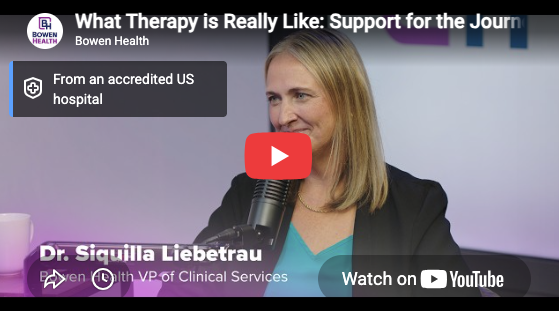
In Part 2 of What Therapy is Really Like, the conversation turns to group therapy and the connection that can happen when people come together around shared experiences. We explore the “magic of group,” common misconceptions about what group therapy is really like, and why hearing from others who are navigating similar challenges can be such a meaningful part of the healing process.
Whether you’re curious about group therapy, nervous about joining a group, or simply want to better understand how it works, this episode helps take away some of the mystery and shows why healing doesn’t always have to happen alone.
Watch the video on our YouTube channel, listen to the audio-only version on your preferred platform, or read the episode transcript below!
Vodcast
Audio
Transcript
-
0:06
Welcome back to the Bowen Health podcast where we talk about real life, real health and what it means to take care of your whole self.
0:13
I'm Tess Otenweiler, Vice President of intensive Services with Bowen Health and I am joined again with Doctor Sequilla Liebetrau, our Vice President of clinical Services here at Bowen Health.
0:24
I'm so excited to have her back for our two-part episode.
0:28
This is Part 2 where we are taking a closer look now at group therapy and ways group therapy can help navigate challenges.
0:37
Welcome back, Doctor Lee Batrau, thank you.
0:40
Thank you for being here again.
0:42
We had a really great first part of our episode.
0:45
So if anybody listening missed that, please join us for Part 1 where we talked about individual and family therapy and all the amazing things and tools and supports you can receive in that service.
0:58
And now we're back to group therapy.
1:00
So let's go back to basics again.
1:03
I know we started off in our first episode talking about what a lot of people think about therapy might come from the movies.
1:11
And I think that that's probably true of group therapy as well.
1:15
So give us the real deal.
1:17
What is group therapy?
1:19
Yes, definitely what not what you see in the movie.
1:22
So I feel like typically in the movies it seems pretty scary and wild.
1:28
And so in the real world, I would say the big thing is that it is a safe space to be able to work on things that are important for you to work on.
1:41
The magic, the true magic of group, I think, is that you have the opportunity to process through some things with folks that are struggling with similar things.
1:55
And that is really, really special because it helps you feel like I'm not a freak of nature because we all have these mean thoughts that we have towards ourselves in our head, right?
2:09
I'm so broken that nothing can fix me.
2:12
And so just being in the presence of other folks that are struggling with similar things can just be very normalizing.
2:20
It kind of gives you that sort of okay things.
2:25
Things are not as bad as I thought they are.
2:28
But then as things unfold too, there's the opportunity to learn and grow in that safe space where you can try things out a little bit before you try them in the real world.
2:41
We are, we're social beings and so part of our learning is social learning.
2:47
So sometimes even just by being in a group, even if you don't speak out because you might be nervous about talking in the group or sharing anything, you're just kind of trying it out at first.
2:59
Just by being in the presence of other folks working through their difficult or being able to see that somebody else struggled with something similar and they're further ahead in the process.
3:12
It helps us almost through osmosis.
3:15
You're you're seeing it happen.
3:17
You're seeing it's possible you develop hope, you develop your courage.
3:24
You practice a little bit, then you feel a little bit braver and you get to practice a little bit more.
3:32
And we hold each other accountable in Group 2.
3:35
If you've just sort of been, you know, sitting back and seeing everybody do their thing, but you're not doing your thing, you're the other group members will say, hey, test, like what's up with that?
3:49
So we really hold each other accountable.
3:51
But it's really again, in a safe space and in a healthy way where you can then say, you know what, you're right, I, I've been holding back.
3:58
Let me give this a little bit more.
4:01
So it's that real world, but also safe and it's not just a group of folks sitting around.
4:09
It also has the added benefit of having a trained professional.
4:13
The therapist is facilitating the process.
4:16
So helping to unstick things where they get stuck, helping to just kind of set the tone with a question or an exploration it.
4:29
It could be an opportunity to introduce a new skill or a new technique and maybe we get to practice together together.
4:37
So it is a controlled environment for learning and growth.
4:43
So you had so many good things that you just said there, and I want to touch on a lot of them, but I want to go back to first, the first session.
4:51
So if I've never been to group before, I'm probably nervous walking into that first session because I don't know what to expect.
4:58
Now, you did just tell us many things.
5:01
However, one of the things I picked up on was I don't have to talk a lot during session if I don't want to.
5:07
So.
5:08
So what do I expect my first group session?
5:11
Yeah.
5:11
So come in just with the mindset of I'm just here to observe and learn.
5:20
And some people go in and they go, oh, this is really cool.
5:23
And they jump in and they, they do the thing the first session.
5:27
And somebody else might be a little bit more reserved, may be scared, honestly.
5:33
Maybe you've been holding onto these secrets or behaviors or symptoms for such a long time that you're not quite sure you're ready to change or you just don't want to tell other people because you think they're going to judge you.
5:50
That's OK.
5:51
Just come see how it works, see how other people are doing it.
5:58
And as you're ready, as you're warming up, you do your thing, you join the group.
6:03
I love that.
6:04
Another thing that you said was hope.
6:07
And the installation of Hope is so big.
6:10
Oh my gosh.
6:11
So you do feel really alone sometimes in your own thoughts, in your own head, when you're not in treatment, especially at night time.
6:19
Sometimes I'm just thinking about so many people.
6:22
And I, I work in crisis services a lot with that team.
6:26
And we hear a lot of people say, I just don't want to feel alone anymore or I just don't want to be alone anymore.
6:34
So when you were talking, I just kept thinking how amazing that social connectedness of group to instill that hope that you're not alone.
6:42
Other people are struggling with similar things.
6:45
Talk to us about hope.
6:46
Absolutely hope.
6:48
I would say like water and food is a is a key ingredient, ingredient of human survival.
6:56
If you don't have hope, what do you have?
6:59
So having a way, I think we always say that if you're in a place where you maybe don't have hope inside of you right now, come and we'll help you have hope.
7:13
We can be the hope for you until you truly believe in in your heart and your soul.
7:20
Yeah, I see a little bit of glimmer of hope.
7:22
It's far away.
7:23
It's really far away.
7:24
And it seems seems really tiny, but I have it now.
7:27
Until you have even the smallest glimmer, we can be that for you.
7:32
And so when you've got that group, it kind of contains you a little bit and helps you believe, yeah, that it's possible.
7:42
And then you can take the next step.
7:44
So really just as humans, we're we're we're, we are designed to be in community and our world these days, everything is so separate.
7:56
You know, with technology is great.
7:59
It brought a lot of good things, but it also brought, I think more social isolation.
8:03
So you might be texting people or you might be virtually connected and there's nothing wrong with that, but it's just not quite the same.
8:13
And so if you're missing that sense of just connection, belonging, opportunity to kind of step back in, but in a Safeway, yeah, that's group.
8:28
I love that.
8:30
So one of the things that I started thinking about when you were talking is we did talk about family therapy and individual therapy in the in the last part of the episode.
8:42
What if I'm in individual therapy and I would also like to be in Group therapy?
8:48
Are they separate?
8:49
Can can I do that?
8:51
Do they complement each other?
8:53
Of course you can.
8:54
How does that work?
8:55
Yes.
8:55
So first of all, our philosophy at Bowen, as always, we need to take care of your needs.
9:02
And if this is something that you've identified and sometimes as you might say, hey, this is something I think I want to try, or your therapist might suggest it, or your psychiatrist.
9:13
Oh, yes, OK.
9:14
Or your primary care doc, anybody in our continuum or your dentist, somebody in our continuum might say, hey, I think this group is really going to be a great fit for you.
9:27
Do you want to try it out?
9:29
But getting back to I went really broad, incredible though, incredible that you can be at the dentist and the dentist can suggest a group that might really anxious today.
9:38
I know it's around the procedure, but it seems like it's bigger than the procedure.
9:43
We've got this group for folks with really severe anxiety.
9:46
Would you like to try it?
9:48
Yes, so cool.
9:49
Yes.
9:49
So that's the beauty of integrated care too, but I digress.
9:54
So getting back to can you do individual and group together together?
9:59
Yes, absolutely.
10:01
So the difference is when you're an individual, your, your individual therapist is really going to hone in on some of those pieces that you feel maybe are more private or that you need more sort of one-on-one focus on maybe that you're not quite ready to share with others or that's a very intimate journey for you.
10:23
And then there might be other things where there really is that need or the desire to maybe practice within a community to have the support of the community, that extra nudge, the extra encouragement.
10:39
And those can be beautifully supplemented where you make some progress on some things, an individual and progress on other things in Group.
10:51
Honestly, the, the, the better you do in one or the other, it, it helps, it helps you overall for you to just feel more confident and to feel like you're just, you're, you're just rocking it.
11:03
You're you're doing things, you're improving, you're feeling healthier.
11:08
I love the combination of both.
11:09
OK.
11:10
It sounds like an incredible compliment to one another.
11:13
Absolutely.
11:14
OK, so one of the things that people may not realize is there are so many different topics that can be covered in Group.
11:22
So talk to us.
11:24
I know we have a lot of topics covered at Bowen Health.
11:26
Talk to us about what we offer either at Bowen Health or maybe we're going to in the future, But what does group talk about?
11:33
Yeah.
11:34
So we have some groups, fan favorites that specifically relate to substance use or addiction.
11:45
That is a world that can get incredibly scary, incredibly stigmatizing, incredibly lonely if you've maybe struggled with with an addiction for a while.
12:01
It can be isolating.
12:03
Sometimes we burn bridges through the bad choices that we make once once you kind of go down that path of an addiction.
12:10
And so finding community again, finding a healthy network to help you heal is so incredibly important.
12:22
And sometimes part of that looks like maybe you're in a support group elsewhere, or maybe you're working with a spiritual leader in the they're helping you with that, or maybe you're working with a neighbor.
12:35
But this is another piece, another supplement where you are walking the journey with other people that are also seeking to recover and heal.
12:47
And we take an approach, approach where you don't have to be like completely clean and sober.
12:56
That's sort of old school.
12:58
Or in some models, they'll say, yeah, even that word clean, right?
13:02
We hate even using that anymore.
13:03
It's just old ugly word.
13:05
But but that terminology still floats out there where they say if you have one, one drop of alcohol, you can't be in this group or if you're using this substance or this much or whatever, you, you can't, we're saying any progress.
13:25
If you've gone from 12 drinks a day to 11 drinks a day, that's progress and that's healing.
13:34
And we want to be on that journey with you.
13:37
So taking that approach and being an environment of support and having other people that cheer you on along the way, so powerful.
13:49
So we have a large variety of groups specifically for folks struggling with addiction.
13:57
So that's kind of one category.
13:59
We have a lot of mental health related groups.
14:04
So it could be that you're struggling with a combination maybe of depression and anxiety or just depression or just anxiety.
14:14
We have groups that are tailored that sort of a combination of addiction and trauma.
14:20
We find that trauma history is very common with folks that struggle with addiction.
14:26
We have those.
14:28
So really I, I would say just looking into it, exploring, there's so many group options, group for grief, so many, so many group options.
14:42
One group type that is a little bit newer for us that's really just starting to get so exciting with all the opportunity.
14:53
We call them, the category is sort of health behavior groups and people might go what, what is that?
15:01
So it's where there is a health related condition that you're really struggling with that maybe your doctor says you need to lose weight or you need to get your A1C under control or whatever the case may be.
15:15
Hopefully they won't say it in in that tone.
15:17
And, and I believe that if you're at Bowen, they won't say it that way, but maybe they're, they're saying your health is really suffering.
15:26
What can we do to help you, to encourage you, to support you?
15:31
We've got this group.
15:33
Do you want to try it out?
15:34
And so these health behavior groups are specifically focused around lifestyle and behaviors that you could change to really help your health improve.
15:45
So it might be a weight management group, it might be a pain management group.
15:51
People don't always think of pain as something that a therapist can help you with or that group could help you with.
15:57
I think traditionally people sort of think, well, it has to be a medication or a surgery, but there are so many evidence based interventions for pain where really the research shows the outcome is better, believe this or not, better than medication management.
16:17
And so there's just so much opportunity with these health behavior groups where you know, if you've ever tried to lose weight or if you've ever tried to just live with a chronic health condition, it's hard.
16:31
It's so hard.
16:31
It's it's, it's a lifetime, it's lifestyle changes.
16:36
It's not a 11 and done and we're all good.
16:39
You have to live with these things.
16:43
And so you need somebody to support you.
16:45
You, you need somebodies.
16:47
I would argue you need a village.
16:49
And so a Group, A health behavior group, can be a really great village for you to help support some of those health behavior needs that you might have.
17:01
I love the health behavior groups.
17:04
And I think it just speaks more to the integrated care model that we follow at Bowen Health.
17:10
And you did talk a little bit about that right there and then at the beginning as well.
17:15
Is there anything else you want to cover as far as how groups really fit into that integrated care model?
17:22
Absolutely.
17:22
It's, I would say it's one more tool in a toolbox.
17:26
And if you look at integrated care and it fits within that larger chronic care model, we want to make sure that we take care of all the parts of you as a human.
17:41
And so whether you're in individual therapy and group therapy or maybe just group therapy, or you're going to our primary care doc and you're getting maybe psychiatric medication management, those pieces can all work together.
17:58
That's the idea.
17:59
Let's give you more tools instead of saying here's one tool, fix everything with the one tool.
18:06
We know how that goes.
18:08
If you have just a hammer, everything is going to be a nail, right?
18:12
And so if you're building a house, you need more than a hammer.
18:16
As humans, we're the same.
18:18
We're complex human beings.
18:20
And so we've got complex needs.
18:22
Sometimes group is a great fit.
18:28
Another time you might say, you know what, I really not, not today, not for this.
18:33
And that's OK.
18:34
Just knowing that there are different options and opportunities and you can tap into those whenever you need them.
18:42
Well, and I love that you keep coming back to you might be seeing us for primary care or dental or group or individual psychiatric services, all of these different pieces.
18:50
And that can sound like a lot, I think, right?
18:54
Just I don't know what was that like 6 things real quick.
18:58
But then when you talk about it works for you and whatever is going to work for you.
19:04
So that might be once a week, you're coming in, it might be once a month.
19:07
So it's not getting all of these things every day of the week, right?
19:12
I also want to go back to accessibility, right?
19:15
Because we talked about it during the other one.
19:17
So if I have these services that I want to participate in, but I have parenting responsibilities and I have transportation challenges and I am busy with work or I'm busy with school and I'm busy with all these other things, is group something else I might be able to do virtually?
19:35
Yes, it is.
19:37
And I'm so excited about this.
19:39
We have been working at really just expanding group offerings a lot.
19:43
We found that, you know, in some of the larger communities.
19:47
So let's say, for instance, if you are in the Fort Wayne area, we've we've got a larger population just in a larger area and so we can run all kinds of groups there.
20:00
But when you get in some of our smaller communities, it's harder to have a group available for all the things because you might have one person wants to go to a grief group, maybe there's three people that want to go to a parenting group, but you know, just not quite enough to make it like.
20:20
Really get the magic of group going and so by offering these virtual opportunities you get to connect for with people from all walks of life truly from all of the communities that we serve within the catchment area.
20:39
That's Bowen.
20:40
Honestly, we are able to serve folks all over Indiana.
20:44
So you know, if your cousin that lives in Muncie or wherever, as long as they're in Indiana, that's the other thing.
20:53
Some people just don't have access because they're so far away from any mental health facility.
21:00
We can be a resource for those folks as well.
21:04
So really just knowing that there's now this great opportunity and, and that magic potion that is group therapy, it works, works on a virtual platform too.
21:15
You're in Group, the therapist is there, the other members are there.
21:20
You still get an opportunity to communicate back and forth.
21:23
You still get an opportunity to try things in a safe environment.
21:27
You still get to speak when you want to or, or when you don't.
21:32
All of those key ingredients are there, but you don't have to worry about the, you know, your commute there, your commute back, taking extra time out of your day.
21:43
I've heard so many very, very busy parents say, you know what?
21:46
My kids are old enough that I could just like put them in another room and they're busy.
21:52
So I don't even have to worry about getting childcare.
21:55
So that's another box check.
21:57
I can get them.
21:58
They're busy in another room, but I can close my door and I can have my group therapy in a private space in my home.
22:07
And it, it goes quicker 'cause I don't have to worry about the commute.
22:11
My kids are safe and that's so important as a parent.
22:15
It, it just checks so many boxes.
22:17
And really it's, it's the same experience.
22:20
One of the things I was thinking when you were talking, and I think a lot of people might have this question is so we know that adults can be in Group.
22:28
Who else benefits from group?
22:29
Can teenagers or are there youth groups?
22:33
Yeah, we're just starting to explore that piece.
22:36
I think it's trickier sometimes to get the word out, but we're definitely exploring groups.
22:42
So one one thing that's come up over and over and schools are begging for help and parents are begging for help.
22:50
Vaping.
22:52
Vaping is so big and and marketing is so focused on our youth and we now know research really tells us it's very healthy.
23:03
It can be very dangerous.
23:05
It can have very long lasting impact.
23:09
These products aren't regulated.
23:11
So if you maybe maybe have a substance in there that you know, impacts brain development, there's so many things to consider.
23:20
Long story short, vaping, vaping just keeps coming up over and over and over.
23:24
And so your teen might benefit from a vaping group and it's, and again, the magic sauce there is you're in a group with peers.
23:33
So it's not a grown up telling the kids what they can or can't do or what they're should or should because the minute you do that, yeah, they're out right turned off.
23:42
Having that component of peer-to-peer interaction and peers supporting each other is, is just phenomenal.
23:50
So yes, you still have a therapist, an adult that's the facilitator, but you have your peers that speak your same language, that have your same life experiences and struggles.
24:01
And so it's just, it just makes it that little bit easier to navigate the problem that you're struggling with.
24:10
What would you say to someone who's nervous about trying?
24:13
Gosh, the first time you try anything, it's a little bit nerve wracking, right?
24:18
But just give it a shot.
24:21
It is, it's truly such a great opportunity to grow and feel empowered and and to just feel supported to have that that team that rallies around you.
24:41
Something I've heard from from patients before as well, in individual therapy, sometimes they'll say, well, you're my therapist, so you're getting paid to tell me that I'm doing good or that you're paid to listen to me.
24:55
I love doing therapy and that's not how therapists feel.
24:59
But sometimes there's that added validation from the group members that, hey, you're on track, you're doing good, we can see you're doing good.
25:11
And hey, I'm also struggling with this thing.
25:15
So it's that mutual support and validation from somebody other than the therapist.
25:21
Your therapist will also give it to you, but somebody other than your therapist saying it is incredibly helpful.
25:29
OK, Doctor Liebachau, you have talked a lot about the magic of group therapy, and we know that you've been doing this for a long time.
25:38
Are there any stories or anything that kind of hits you that you remember in your group therapy days?
25:47
Oh, my gosh.
25:50
Well, of course I would never want to give away personal patient information, but I I, I can give some some examples without sharing too much.
26:03
I've definitely had different experiences.
26:06
I will say one comes to mind where patient was just incredibly quiet and holding back and you could tell in the in the body language kind of just closed off, not making eye contact.
26:28
And and sometimes I was wondering, are they are they getting anything out of group?
26:34
But but they they keep coming.
26:36
So let's just let let this go.
26:41
And there was just one day where they almost like just word vomited.
26:46
Everything came out, everything came out.
26:49
And it, it seemed like from that moment forward, it, it just kind of clicked.
26:55
And so it just took them longer.
26:57
It just took them a little bit longer.
26:59
And that's OK.
27:02
I, I've different, different situation.
27:06
I've, I've had a group member that I've been through Group A couple of different times, not all with me, but over time they struggle with addiction and, and it's just, it's devastating what that can do to your life or the life of your loved ones.
27:25
It, it, it can break your heart and break your loved ones hearts trying over and over and over and over.
27:34
And this particular group member had been in Group several times, but but this this time around, they were just spewing off the things like they were the group leader.
27:49
And I'm, I'm sitting back going, I don't even have to do anything.
27:54
They're holding everybody else accountable around them.
27:57
And they're talking about, you know, I learned this and it's really true.
28:00
You have to do this.
28:02
And it just helped me reflect that even some of those previous groups, some of them were mine, some of them were not even my my groups or, or, or our organization.
28:14
But those seeds that you plant, even if you think it's not making a difference, it all matters.
28:22
And so sometimes it just takes time.
28:25
It takes the right environment and and I was just blown away by this group member that was able to just talk about all the things they'd learned over time.
28:37
They'd internalized the material, they made it their own to be able to then help and support the other group members.
28:46
And then that information coming from them meant so much more to the group than when it was coming from me because they had the lived experience, they had the struggles, they had that, the scars of addiction along the way.
29:03
And So what they had to say was so much more powerful to everybody in the group.
29:09
Oh my gosh, I love that.
29:11
And you know, you speak to such an important piece, addiction, substance use disorder is a chronic condition.
29:18
So how normal to go through group or go through treatment?
29:23
And you might need it again and you might need it again and you might come back again.
29:27
And that's OK.
29:27
And then it clicks.
29:29
Well, and we also learn things along the way, right?
29:32
You could have a lapse and come back, but you're not starting back at square one.
29:39
You're starting at a new place because you've learned things the last go around.
29:44
So nothing is for nothing.
29:47
You've learned things.
29:48
You're better this time around.
29:49
You're stronger this time around.
29:52
Even if you don't feel it.
29:54
You are stronger this time around.
29:57
You're you're one step closer to freedom from addiction.
30:02
I love that.
30:03
And I think that's such an incredible message for somebody listening who may be wondering, should I come to group?
30:10
Should I come back to group or a loved one of someone that should I ask them to go to group again?
30:17
Should I, should we do this again?
30:19
Should I go to group again?
30:20
Give it a try.
30:21
Give it a try and and you bring up a whole separate point.
30:24
The person that's struggling, yes, absolutely their loved ones.
30:28
Sometimes you need your own support.
30:30
It can be physically and emotionally exhausting.
30:34
It can be draining to just go.
30:37
Are we doing this again?
30:39
I guess this time number 45, yes, do it because you deserve it.
30:46
Your loved ones deserve it.
30:49
Go for it.
30:50
Just go for it.
30:52
Incredible.
30:53
Well, thank you very much, Doctor Libetrau for joining us today and sharing your expertise.
30:58
And thank you to all the listeners who listen to us today.
31:02
If you'd like to learn about mental health services, substance use, recovery services, primary care, or dental at Bowen Health, feel free to go to goandhealth.org or reach out to us at 1-800-342-5653.
31:18
Until next time, take care.
Share this Podcast!